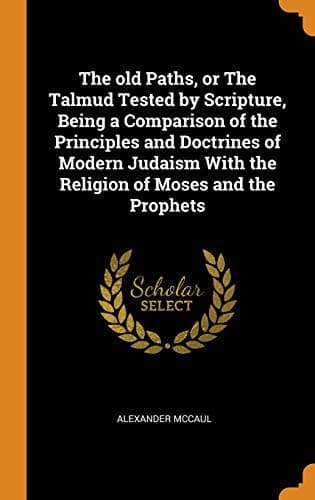
The old paths, or the Talmud tested by Scripture: Being a comparison of the principles and doctrines of modern Judaism with the religion of Moses and the prophetsMcCaul, Alexander
Religion
The old paths, or the Talmud tested by Scripture: Being a comparison of the principles and doctrines of modern Judaism with the religion of Moses and the prophets
McCaul, Alexander
Judaism -- Works to 1900
The principle does not hold in the ordinary
judicial proceedings of this world: a robber or a murderer is not and
cannot be pardoned because another member of the community, or of his
family, is a good and righteous man. We must therefore look elsewhere
for the origin of the principle, and we find it in the revealed will of
God. We see it in the appointment of sacrifice and atonement, according
to which a guilty man was pardoned by the suffering of an innocent
animal. Here is at once the principle of substitution of the innocent
for the guilty; and human reason, when it once has the substratum, can
easily proceed to erect the superstructure. In the present case it
naturally argued, if the death of one of the brute creation could effect
so much, how much more would the merits of a righteous man avail, if
such an one could be found? The error, then, is not in the principle,
but in its application. According to the Scripture, it is true that the
innocent may be substituted for the guilty; but the rabbies were wrong
in applying this truth to the case of Abraham, Isaac, Jacob, and other
men, who were only sinners as themselves. The Word of God, which gave
the principle, also directs us to the right application. It tells us of
one for whose righteousness’ sake the Lord will forgive sin:—
ה׳ חפץ למען צדקו יגדיל תורה ויאדיר ׃
“The Lord is well pleased for his righteousness’ sake; he will magnify
the law and make it honourable.” (Isa. xlii. 21.) Who, then, is this
person? The preceding verses tell us that it is the servant of the Lord.
Who, then, is the servant of the Lord? Kimchi says, on this verse, that
the servant of the Lord is the prophet; but this cannot possibly be
true, for the prophet was not righteous, but a sinner, as he himself
tells us in the sixth chapter—“I am a man of unclean lips.” The servant
mentioned in the nineteenth verse is the same person as he who is called
“My servant,” in the first verse of the chapter—“Behold my servant, whom
I uphold, mine elect, in whom my soul delighteth: I have put my spirit
upon him: he shall bring forth judgment to the Gentiles.” But here
Kimchi says,—
זה הוא מלך המשיח כמו שפירשנו ׃
“This is the King Messiah, as we have interpreted.” If then, in the
first verse, “The servant of the Lord” means the Messiah, it must mean
the same through the chapter, and the Messiah is the person for whose
righteousness’ sake the Lord is well pleased.
This same prophet tells us again, concerning this servant,—
בדעתו יצדיק צדיק עבדי לרבים ועונותם הוא יסבול ׃
Public-domain text, read in full here on John Shaqi.
Reviews
Reviews
No reviews yet
Be the first to share your thoughts on this work.
Elsewhere in the archive
Join the Discussion
Join the discussion
Sign in to leave a comment or review.
Sign InorCreate an account