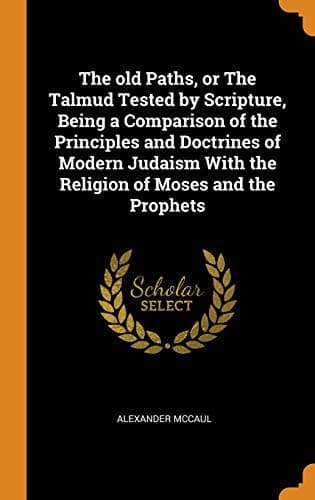
The old paths, or the Talmud tested by Scripture: Being a comparison of the principles and doctrines of modern Judaism with the religion of Moses and the prophetsMcCaul, Alexander
Religion
The old paths, or the Talmud tested by Scripture: Being a comparison of the principles and doctrines of modern Judaism with the religion of Moses and the prophets
McCaul, Alexander
Judaism -- Works to 1900
The progress of the year brings with it again that season, in which God
commanded his people to observe THE FEAST OF TABERNACLES; and the
constancy with which Israelites in every part of the world still observe
the rites and customs handed down by their forefathers, necessarily
commands respect and admiration. When we remember the many centuries
during which their dispersion has continued, the universal oppression
which they have been compelled to suffer, and the unmerited contempt
with which they have had to contend, we cannot but honour the strength
of moral courage which they have displayed, in thus observing and
handing down to their children a religion, which has been the cause of
their misfortunes. But this very constancy, and the respect which it
begets, naturally leads us to inquire whether the religious system
itself be true, and, therefore, worthy of that fidelity with which it
has been preserved; and, above all, whether this constancy is such as at
the last great day to meet the approbation of Him who judgeth not as man
judgeth. The professors of this system think, of course, that it is, and
that by observing these rites and ceremonies, they are keeping the
commands of God, and thereby ensuring his favour; and with regard to the
observance of the Feast of Tabernacles in particular, they are taught to
believe that they alone are so important, as at the day of judgment, to
prove Israel’s obedience, and the disobedience of the other nations. We
will first state the doctrines of modern Judaism on this subject, and
then examine whether they be well founded. In the Synagogue Prayers for
this feast we find it stated, that the construction of a tabernacle
according to rabbinic prescription, is a work of merit:—
חשובה ארבע אמות על ארבע , פסולה פחותה מארבע , כדי לזכות עם רובע ׃
“It must be four cubits long, and four cubits broad: but if it be less,
it is profane; that it may render the people of Israel meritorious. (P.
116.) And a little lower down, after describing the feast in Paradise on
the salted Leviathan and Behemoth, it adds, that this one precept will
form the last trial vouchsafed to the Gentiles, and that their
unwillingness to keep it will prove the cause of their final
condemnation:—
נכנסין כל האומות לדין , פני יושב על כסא דין , ובצדק אותנו ידין , סדר
מצוותיך תן לנו ונקימה , ונזכה עם אלו בנחמה , שגיא כח שוכן רומה , עליון
השופט כל באמונה , ישמיע להם בתבונה , יש לי מצוה קטנה , פירוש סוכה ושאליה
, ארבע דפנות וצל עליה , אל תרחקו מאליה , צללים לעשות בה יעטו , וחמה קדחה
עליהם ולוהטו , וברגליהם יבעטו , קדוש ישפוך עליהם חימה , ויפילם בגיהנם
בלי רחימה , במדרגה התחתונה במהומה ׃
Public-domain text, read in full here on John Shaqi.
Reviews
Reviews
No reviews yet
Be the first to share your thoughts on this work.
Elsewhere in the archive
Join the Discussion
Join the discussion
Sign in to leave a comment or review.
Sign InorCreate an account