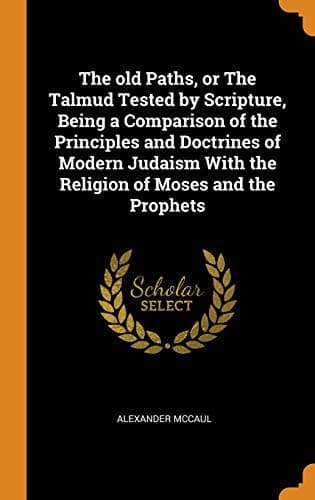
The old paths, or the Talmud tested by Scripture: Being a comparison of the principles and doctrines of modern Judaism with the religion of Moses and the prophetsMcCaul, Alexander
Religion
The old paths, or the Talmud tested by Scripture: Being a comparison of the principles and doctrines of modern Judaism with the religion of Moses and the prophets
McCaul, Alexander
Judaism -- Works to 1900
sick, and ye visited me: I was in prison, and ye came unto me. Then
shall the righteous answer and say, Lord, when saw we thee an hungred,
and fed thee? or thirsty, and gave thee drink? when saw we thee a
stranger, and took thee in? or naked, and clothed thee? or when saw we
thee sick, and in prison, and came unto thee? And the King shall
answer and say unto them, Verily I say unto you, Inasmuch as ye have
done it unto one of the least of these my brethren, ye have done it
unto me. Then shall he say also unto them on the left hand, Depart
from me, ye cursed, into everlasting fire, prepared for the devil and
his angels: for I was an hungred, and ye gave me no meat: I was
thirsty, and ye gave me no drink: I was a stranger, and ye took me not
in: naked, and ye clothed me not: sick, and in prison, and ye visited
me not. Then shall they also answer him, saying, Lord, when saw we
thee an hungred, or athirst, or a stranger, or naked, or sick, or in
prison, and did not minister unto thee? Then shall he answer them,
saving, Verily I say unto you, Inasmuch as ye did it not to one of the
least of these, ye did it not to me. And these shall go away into
everlasting punishment: but the righteous into life eternal.” (Matt.
xxv. 31-46.) Such is the view which Christianity sets before us of the
day of judgment, and the principles according to which that judgment
shall be conducted. You will observe that the whole account is
essentially different from that given by the Talmud. In the first
place it represents God as a just Judge, altogether overlooking
nationality; taking no notice of the temporary distinctions of Jew and
Gentile: but fixing his eyes on the eternal features of moral
character, and according to these fixing the eternal destinies of each
individual. In the second place it tends to promote good will and
charity between man and man, for it represents charity or the want of
charity as the main points of inquiry, and the distinctions according
to which the eternal portion of each is assigned. We ask, then, every
impartial and candid Jew to tell us, which of these two accounts are
most worthy of the great God whom we worship? We Christians believe
that the synagogue-worshippers are in error, and they again think us
in error; but we have now before us the doctrines of the two systems
on the most important point in all theology—the principle of final
judgment; by their respective statements, then, on this subject let
each system be judged. Judaism says, that one class of men is to be
saved by the partiality of the Judge, and the other class condemned
simply because they are Gentiles. Christianity says, that all men
shall be tried impartially by one rule, and that neither prepossession
nor prejudice, but justice alone, shall influence the decision. Which,
then, Judaism or Christianity, is most agreeable to the character of
Him of whom the Psalmist says, “He cometh to judge the earth: with
Public-domain text, read in full here on John Shaqi.
Reviews
Reviews
No reviews yet
Be the first to share your thoughts on this work.
Elsewhere in the archive
Join the Discussion
Join the discussion
Sign in to leave a comment or review.
Sign InorCreate an account