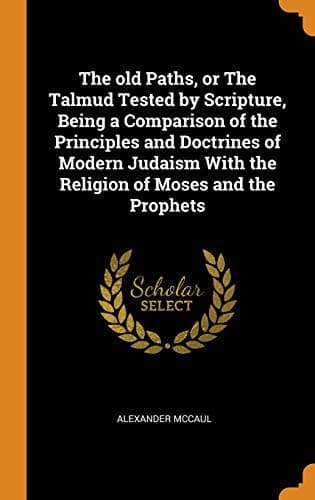
The old paths, or the Talmud tested by Scripture: Being a comparison of the principles and doctrines of modern Judaism with the religion of Moses and the prophetsMcCaul, Alexander
Religion
The old paths, or the Talmud tested by Scripture: Being a comparison of the principles and doctrines of modern Judaism with the religion of Moses and the prophets
McCaul, Alexander
Judaism -- Works to 1900
righteousness shall he judge the world, and the nations with equity?”
We are sure that the good sense of the Jewish nation must decide, that
the impartial justice of the New Testament-representation is most in
accordance with the spirit of the law and the prophets. Nay, we believe
that every devout and thinking Israelite will feel that the Talmudic
picture of God’s judgment misrepresents the God of Israel as much as any
graven image ever deified by heathen idolaters. To suppose that God
would make a mock overture of mercy, or offer a mock trial to any of his
creatures, is to strip him of the attributes of Deity, and to exhibit a
blind and senseless bigot as the object of Israel’s worship. A statement
so abhorrent even from human reason, and so inconsistent with the Word
of God, proves that its authors were not moved by the Spirit, and that
the religion of which it forms a part cannot be divine. But here, as in
many cases which we have already pointed out, the New Testament avoids
the error of the Talmud, and teaches the doctrine conformable to the
law, and in accordance with right reason. Let the advocates of the oral
law explain the fact.
But this Talmudic representation of the day of judgment is not only
opposed to reason and Scripture, but also seems to contradict other
statements of the oral law. Here the Gentiles appear to be marked out
for destruction; whereas, we are told elsewhere, that the pious of the
nations of the world are to have a part in the world to come: and that
obedience to the seven commandments of the sons of Noah, is all that is
required from a Gentile. If this be true, what need is there of giving
them the command to keep the Feast of Tabernacles? But, above all, if
they are to be cast down into the lowest hell, as the Prayer-book says,
how can they have a part of the blessings of the world to come? It is at
the very least, the duty of those who advocate the oral law, to explain
this matter to us Gentiles. We cannot persuade ourselves that a
religion, which makes so little provision for the eternal welfare of the
great bulk of the human race, can possibly proceed from Him who is the
God of the spirits of all flesh, the Creator and Preserver of all
mankind. Living daily by his bounty, and receiving all we have at his
most gracious hands we believe that if he makes such provision for our
bodies, He has made still more for our immortal spirits; and therefore,
amongst other reasons, we believe in Christianity; for if it be not
true, there is no spiritual provision for the Gentiles, and God has left
the majority of his rational creatures without any proof of his paternal
affection.
Footnote 33:
היים לעשותם בעולם הזה , ולא למהר דאינו יכול לעשותם לעולם הבא ׃
No. XXXVIII.
PRAYERS FOR THE DEAD.
Public-domain text, read in full here on John Shaqi.
Reviews
Reviews
No reviews yet
Be the first to share your thoughts on this work.
Elsewhere in the archive
Join the Discussion
Join the discussion
Sign in to leave a comment or review.
Sign InorCreate an account