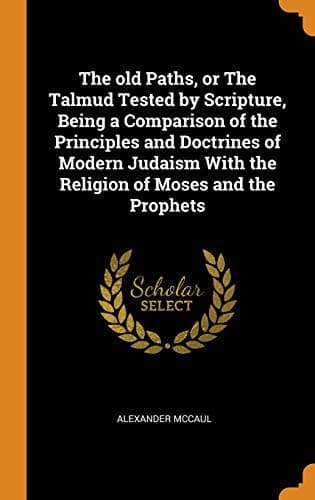
The old paths, or the Talmud tested by Scripture: Being a comparison of the principles and doctrines of modern Judaism with the religion of Moses and the prophetsMcCaul, Alexander
Religion
The old paths, or the Talmud tested by Scripture: Being a comparison of the principles and doctrines of modern Judaism with the religion of Moses and the prophets
McCaul, Alexander
Judaism -- Works to 1900
ourselves to the approval of all the details here specified, we must
acknowledge, that the spirit of this passage is agreeable to the idea of
true charity, and, if universally acted upon, would do more for the
happiness of mankind than some theories now afloat. But though ready to
admire and to acknowledge the general beauty and excellence of this
passage, we must also remark that the main feature of charity is, by the
rabbinical system, excluded. God commands that this help should extend
beyond the narrow limits of selfishness and nationality, to “the
stranger and the sojourner,” but the oral law neutralizes the
mercifulness of God’s commandment by making the word stranger signify a
proselyte to Judaism. The original Hebrew word גר (_Ger_) plainly means
a stranger, as may be seen in the words of Moses—
ואהבתם את הגר כי גרים הייתם בארץ מצרים ׃
“Love ye therefore the stranger; for ye were strangers in the land of
Egypt.” (Deut. x. 19.) It is certain that the Israelites were not
proselytes, but strangers; this word, _Ger_, therefore, signifies
stranger, not proselyte; and yet the oral law says that no one can be a
_Ger_ without sacrifice, circumcision, and baptism, or now, that there
is no temple, without the two last requisites:—
ובזמן הזה שאין שם קרבן צריך מילה וטבילה וכשיבנה בית המקדש יביא קרבן , גר
שמל טבל או טבל ולא אינו גר עד שימול ויטבול ׃
“At the present time when there is no sacrifice, circumcision and
baptism are necessary, and when the temple is rebuilt, he must bring a
sacrifice. A _Ger_ who is circumcised but not baptized, or baptized but
not circumcised, is not a _Ger_, until he be both baptized and
circumcised. (Hilchoth Issure Biah, c. xiii. 5, 6.)” This rabbinical
definition of what is meant by _Ger_, restricts the exercise of charity
within a much narrower limit than that prescribed by God, and does, in
fact, destroy one of the most beautiful features of the Mosaic law,
namely, the merciful provision which it makes for the relief of the
stranger. The law of Moses has the spirit of its divine Author. He calls
himself “a jealous God,” and it may well be called a jealous law,
watching carefully over every departure from truth, and punishing it
rigorously: and yet, like God himself, this just jealousy is tempered
with mercy, and beams with love. The oral law, on the contrary, is an
envious and vindictive code, and its zeal degenerates into
narrow-hearted bigotry. It would not only punish the idolater, but
exclude every stranger from the pale of charity, unless he be a
proselyte; and an Israelite too, if he had in any wise dared to
transgress the rabbinical commands. A remarkable instance of this
hatred, to those whom it considers apostates, occurs in these laws
respecting almsgiving. The oral law says, that the most meritorious
exercise of charity is, the ransoming of captives:—
פדיון שבוים קרדם לפרנסת עניים ולכסותם , ואין לך מצוה גדולה כפדיון שבוים
׃
Public-domain text, read in full here on John Shaqi.
Reviews
Reviews
No reviews yet
Be the first to share your thoughts on this work.
Elsewhere in the archive
Join the Discussion
Join the discussion
Sign in to leave a comment or review.
Sign InorCreate an account