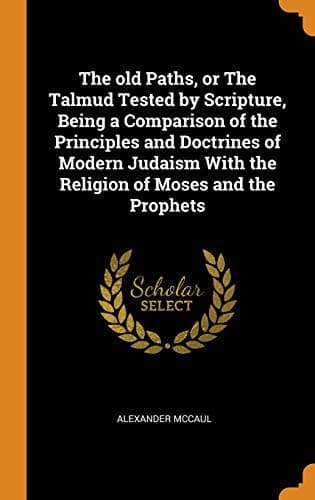
The old paths, or the Talmud tested by Scripture: Being a comparison of the principles and doctrines of modern Judaism with the religion of Moses and the prophetsMcCaul, Alexander
Religion
The old paths, or the Talmud tested by Scripture: Being a comparison of the principles and doctrines of modern Judaism with the religion of Moses and the prophets
McCaul, Alexander
Judaism -- Works to 1900
“And of Levi he said, Let thy Thummim and thy Urim be with thy Holy One,
whom thou didst prove at Massah, and with whom thou didst strive at the
waters of Meribah: who said unto his father and mother, I have not seen
him; neither did he acknowledge his brethren, nor knew his own children:
for they have observed thy word, and kept thy covenant. _They shall
teach Jacob thy judgments, and Israel thy law._” (Deut. xxxiii. 8-10.)
And as this doctrine forms a part of Moses’ last words, so also it is
found in the last prophetic message which God vouchsafed to Israel.
Malachi, the last of the prophets, reminds Israel—
כי שפתי כהן ישמרו דעת ותורה יבקשו מפיהו כי מלאך ה׳ צבאות הוא ׃
“That the priest’s lips should keep knowledge, and they should seek the
law at his mouth: for he is the messenger of the Lord of hosts” (Mal.
ii. 7): so that if there be any one thing more plain than another in the
Old Testament it is this, that the sons of Levi are the
divinely-appointed religious teachers of Israel, and that it is the duty
of all Israelites to seek instruction from them.
It cannot be said that the priests are not now well known, and that on
this account these commands have lost their force; for those who believe
in the oral law, profess to know the family of Levi, and in the
synagogue, at the reading of the law, the priest and the Levite are
called up in a certain order:
בכל קריאה וקריאה מאלו כהן קורא ראשון ואחריו לוי ואחריו ישראל , ומנהג
פשוט הוא היום בישראל שאפילו כהן עם הארץ קודם לקרות לפני חכם גדול ישראל ׃
“At every time of reading the priest reads first, and after him the
Levite, and after him the Israelite. And the simple custom of the
present time is, that a priest, even though he be an unlearned man
(amhaaretz), takes precedence in reading before the most learned, who is
only an Israelite.” (Hilchoth T’phillah, c. xii. 18.) And as the priests
are thus supposed to be known, so the oral law expressly maintains that
they still retain their priestly office, and are bound to discharge the
duties of it, so far as is possible, in the captivity: and therefore
requires them to bless the people as Moses commanded. Indeed the firm
conviction of the Talmudists on this subject is strikingly exhibited in
their assertion, that a priest, although unlearned, or even notoriously
wicked, is still not exempted from his obligation to perform this duty:—
כהן שלא היה לו דבר מכל אלה המונעין נשיאת כפים אע׳׳פ שאינו חכם ואינו
מדקדק במצוות או שהיה חבריו מרננים אחריו או שלא היה משאו ומתנו בצדק הרי
זה נושא את כפיו ואין מונאין אותו , לפי שזו מצות עשה על כל כהן וכהן שראוי
לנשיאת כפים ואין אומרים לאדם רשע הוסף רשע והמנע מן המצוות , ואל תתמה
ותאמר מה תועיל ברכת הדיוט זה , שאין קבול הברכה תלוי בכהנים אלא בהקב׳׳ה
שנאמר ושמו את שמי על בני ושראל ואני אברכם , הכהנים עושים מצוה שנצטוו בה
והקב׳׳ה ברחמיו מברך את ישראל כחפצו ׃
Public-domain text, read in full here on John Shaqi.
Reviews
Reviews
No reviews yet
Be the first to share your thoughts on this work.
Elsewhere in the archive
Join the Discussion
Join the discussion
Sign in to leave a comment or review.
Sign InorCreate an account