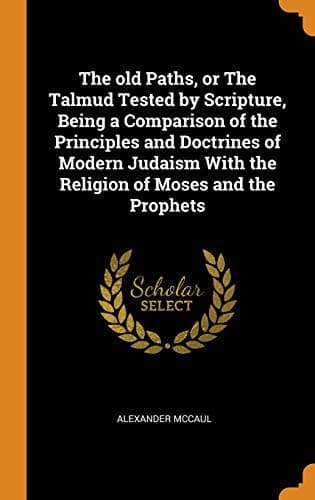
The old paths, or the Talmud tested by Scripture: Being a comparison of the principles and doctrines of modern Judaism with the religion of Moses and the prophetsMcCaul, Alexander
Religion
The old paths, or the Talmud tested by Scripture: Being a comparison of the principles and doctrines of modern Judaism with the religion of Moses and the prophets
McCaul, Alexander
Judaism -- Works to 1900
“And the Lord spake unto Aaron, saying, Do not drink wine nor strong
drink, thou nor thy sons with thee, when ye go into the tabernacle of
the congregation, lest ye die: it shall be a statute for ever throughout
your generations: and that ye may put difference between holy and
unholy, and between unclean and clean; and that ye may teach the
children of Israel all the statutes which the Lord hath spoken unto them
by the hand of Moses.” Here the nature of the priest’s office is clearly
defined. It is, in the first place, to go into the tabernacle of the
congregation, and there to serve before the Lord: and secondly to
instruct the children of Israel in the difference between holy and
profane, clean and unclean, and especially to teach the children of
Israel “ALL THE STATUTES,” which the Lord had given to Moses. The
commission is not only very comprehensive, but very exclusive. If the
priests were to teach “all the statutes,” there is no room left for
rabbies, or Chachamim, or any other description of teacher, the priests
are the only divinely-accredited religious teachers in Israel.
If this passage stood alone, it would be quite sufficient to establish
the doctrine; but it does not. Moses was particularly anxious to impress
upon the Israelites the nature of the priestly office, and therefore
repeats the instruction again and again. Thus in the law respecting a
dead body found lying in a field, after commanding that the elders and
judges should come forth, he adds—
ונגשו הכהנים בני לוי כי בם בחר ה׳ אלהיך לשרתו ולברך בשם ה׳ ועל פיהם יהיה
כל ריב וכל ננע ׃
“And the priests, the sons of Levi, shall come near: for them the Lord
thy God hath chosen to minister unto him, and to bless in the name of
the Lord: and by their word shall every controversy and every stroke be
tried.” (Deut. xxi. 5.) One should have thought that the elders and
judges were enough in such a case. But not so. God had determined that
the priests were to teach Israel “all his statutes,” and therefore
commands that they should be present in this case, that they should give
the decision.
Again, when Moses was about to part from Israel, and to leave them his
dying benediction, he was directed by the spirit of prophecy to impress
upon them the same great truth, and in the most solemn manner:—
וללוי אמר תמיך ואוריך לאיש חסידך אשר נסיתו במסה תריבהו על מי מריבה ,
האומר לאביו ולאמו לא ראיתיו ואת אחיו לא הכיו ואת בניו לא ידע כי שמרו
אמרתך ובריתך ינצרו . יורו משפטיך ליעקב תורתך לישראל וגו׳ ׃
Public-domain text, read in full here on John Shaqi.
Reviews
Reviews
No reviews yet
Be the first to share your thoughts on this work.
Elsewhere in the archive
Join the Discussion
Join the discussion
Sign in to leave a comment or review.
Sign InorCreate an account