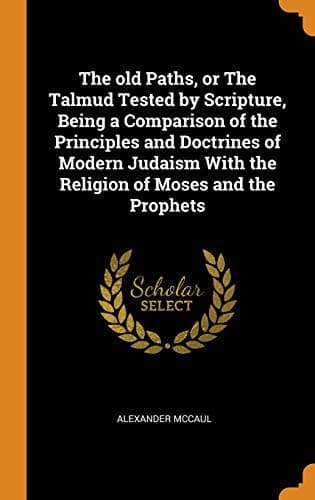
The old paths, or the Talmud tested by Scripture: Being a comparison of the principles and doctrines of modern Judaism with the religion of Moses and the prophetsMcCaul, Alexander
Religion
The old paths, or the Talmud tested by Scripture: Being a comparison of the principles and doctrines of modern Judaism with the religion of Moses and the prophets
McCaul, Alexander
Judaism -- Works to 1900
“They respected not the persons of the priests” (Lam. iv. 16); but it is
equally applicable to the adherents of the oral law. Here and there a
son of Levi may be a rabbi, and then he has the honour attached to the
rabbinical office; but the Mosaic institution of the priesthood, as the
appointed order of religious, teachers to Israel is utterly disregarded.
Moses declares, as we have seen above, that it is the priest’s office
“to distinguish between holy and unholy, and between clean and unclean;”
but if a Jew has got a שאלה, a question or a difficulty, it is to the
rabbi that he goes to get the decision. Moses says that the priests are
appointed by God “to teach Israel all the statutes which the Lord hath
spoken to them;” but now men are made rabbies and Melamm’dim who do not
pretend to be of the family of Levi: and there are congregations even
where there is no Levite nor priest at all, and where, therefore, this
command is utterly despised. But the worst feature in this disobedience
is, that it is systematic. It is not one of the casualties of the
captivity, but it is the deliberate aim of the oral law to degrade the
priesthood, as established by Moses, and to set up above it another
office, that of rabbi, of which Moses does not say one word. The oral
law, instead of deprecating the possibility of an Israelite congregation
existing without a priest a son of Levi, quietly layeth down the law for
doing without them. When prescribing the order in which persons are to
be called up to the reading of the law, it says—
אין שם כהן עולה ישראל ולא יעלה אחריו לוי כלל ׃
“If there be no priest there, then an Israelite is to go up, but no
Levite is to follow him.” (Ibid., c. xii. 19.) And again,
ואם אין להם כהן כלל כשיגיע שליח צבור לשים שלום וכו׳ ׃
“But if the congregation has no priest at all, when the reader comes to
that part of the prayers he is to say,” &c. (Ibid., c. xv. 10.) Now if
the oral law were anxious to maintain the institution of Moses it could
make no such supposition. On the contrary it would urge upon every
congregation the indispensable necessity of having a priest or the
family of Levi. The supposition shows that its authors cared but little
about the commands of Moses, for where there is no priest it is plainly
impossible for the people to obey that often-repeated precept to learn
the law from the sons of Levi. And yet the authors of the oral law, who
care so little for this commandment of Moses about the priests, command
the appointment of Melamm’dim, or schoolmasters, wider pain of utter
destruction—
מושיבין מלמדי תינוקות בכל מדינה ומדינה ובכל פלך ופלך ובכל עיר ועיר , וכל
עיר שאין בה תינוקות של בית רבן מחרימין את אנשי העיר יד שמושיבין מלמדי
תינוקות ואם עוד לא הושיבו מחרימין את הציר ׃
Public-domain text, read in full here on John Shaqi.
Reviews
Reviews
No reviews yet
Be the first to share your thoughts on this work.
Elsewhere in the archive
Join the Discussion
Join the discussion
Sign in to leave a comment or review.
Sign InorCreate an account