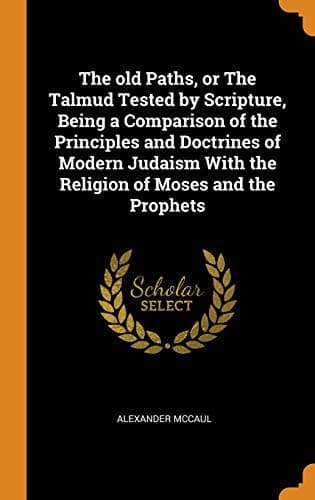
The old paths, or the Talmud tested by Scripture: Being a comparison of the principles and doctrines of modern Judaism with the religion of Moses and the prophetsMcCaul, Alexander
Religion
The old paths, or the Talmud tested by Scripture: Being a comparison of the principles and doctrines of modern Judaism with the religion of Moses and the prophets
McCaul, Alexander
Judaism -- Works to 1900
“Teachers of children are to be established in every province and
district and city. And every city in which there are not school children
the men of that city are to be visited with the Cherem, and if they
still neglect, the city itself is to be devoted.” (Hilch. Talm. Torah,
c. ii.) When we see them enforce this commandment of their own with such
zeal and severity, and yet appear so careless and negligent about the
commandment of Moses, we justly infer that this neglect was intentional,
and that the object was to exalt themselves, and to depress that office
which God himself had ordained, And this inference is abundantly
confirmed by הלכות כבוד רבו, the numerous and minute laws respecting the
honour due to a rabbi, whilst the respect due to the family of Levi is
almost entirely disregarded, and his office evidently depreciated below
that of the former. As, for instance, in establishing the order in which
captives are to be redeemed, the oral law says the priest is to be
redeemed before the Levite, and the Levite before the Israelite, but
then adds—
במה דברים אמורים כשהיו שניהם שוין בחכמה , אבל אם היה כהן גדול עם הארץ
וממזר תלמיד חכם תלמיד חכם קודם ׃
“In what case does this hold good? In case that they were both equal in
wisdom. But if the high priest be an unlearned man, and an illegitimate
child be the disciple of a wise man (chacham), the latter is to have the
precedence.” (Hilchoth Matt’noth Aniim, c. viii. 17.) Here the office of
the priesthood and even of the high priesthood itself is put below that
of the rabbi or chacham, and the intention of the Rabbinists to exalt
themselves, and their utter disregard for the law of Moses and his
commandments, is especially apparent. The high priest was the chief
person in the whole Mosaic dispensation. Without him the blood of the
offering could not be carried into the holy of holies on the Day of
Atonement, and yet the oral law says, that if he and an illegitimate
child, that is, the least honoured person in Israel, be both in
captivity, and the latter be the disciple of a rabbi, he is to be
redeemed first. It is needless to add any further proof of the fact that
the command of Moses, respecting the family of Levi, is systematically
and intentionally transgressed by the authors and adherents of the oral
law. The priests, the Levites, have been thrust out of that office which
God gave them, and others have been made the religious teachers of
Israel who have no right at all to this appointment. How then can the
modern Jews pretend to be zealous for the law of Moses? They are living
in plain and systematic violation of one of his plainest commands. It
will not do to say that the office of rabbi is also of divine
appointment. An assertion which nullities a Mosaic institution must have
the most unexceptionable evidence. Its proof must be at least as clear
as the original appointment. To persuade any real lover of the Mosaic
law that the rabbies have a right to thrust out the family of Levi from
Public-domain text, read in full here on John Shaqi.
Reviews
Reviews
No reviews yet
Be the first to share your thoughts on this work.
Elsewhere in the archive
Join the Discussion
Join the discussion
Sign in to leave a comment or review.
Sign InorCreate an account