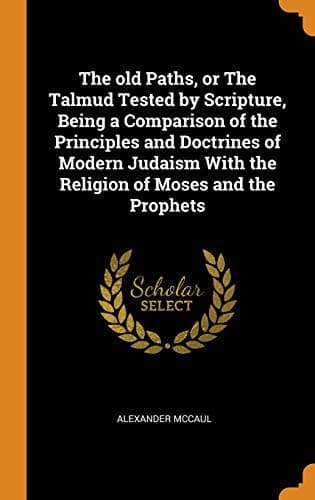
The old paths, or the Talmud tested by Scripture: Being a comparison of the principles and doctrines of modern Judaism with the religion of Moses and the prophets — John Shaqi
The old paths, or the Talmud tested by Scripture: Being a comparison of the principles and doctrines of modern Judaism with the religion of Moses and the prophetsMcCaul, Alexander
Religion
The old paths, or the Talmud tested by Scripture: Being a comparison of the principles and doctrines of modern Judaism with the religion of Moses and the prophets
McCaul, Alexander
Judaism -- Works to 1900
But it goes farther still, and extends
this precept even to an idolater’s infant, which knows not its right
hand from its left:—
בת ישראל לא תיניק את בנה של נכרית מפני שמגדלת בן לעבודה אל כוכבים ומזלות
ולא תילד את הנכרית עכו׳׳ם אבל מילדת היא בשכר משום איבה ׃
“A daughter of Israel shall not suckle the son of a heathen woman,
because that would be to bring up a son for idolatry; neither shall she
act as midwife to a heathen idolatress. But if she should, it must be
for pay, on account of the enmity (that might otherwise be excited)”.
(Hilchoth Accum, c. ix. 16.) What is meant by “pay, on account of the
enmity,” is fully explained in the following passage, which forbids a
Rabbinical physician to cure a sick idolater:—
מכאן אתה למד שאסור לרפאות עובדי כוכבים ומזלות אפילו בשכר ואם היה מתירא
מהן או שהיה חושש משום איבה מרפא בשכר אבל בחנם אסור ׃
“Hence thou learnest, that it is forbidden to cure idolaters even for
pay. But if (an Israelite) is afraid of them, or is anxious on account
of enmity, he may cure them for pay; but to do it gratuitously is
forbidden.” Hence the commonest offices of humanity are forbidden. But
the Talmud goes further still, and prohibits even the giving of good
advice to these outcasts.
ואסור להשיא עצה טובה לגוי או לעבד רשע ... ולא נתנסה דניאל אלא על שהשיא
עצה טובה לנבוכדנצר ליתן צדקה , שנאמר להן מלכא מלכי ישפר עלך ׃
“It is forbidden to give good advice to a heathen or to a wicked
slave.... Daniel was exposed to danger for no other reason than this,
that he advised Nebuchadnezzar to give alms, as it is written,
‘Wherefore, O king, let my counsel be acceptable unto thee.’ (Dan. iv.
23, in English 27.)”[11] A more striking instance of the spirit of the
Talmud can hardly be found. Nebuchadnezzar was the benefactor of Daniel,
and had elevated him from the situation of a captive to the first
dignity of the empire; and Daniel had not refused, but voluntarily taken
upon himself the duties and responsibilities of the king’s chief
adviser. Under such circumstances, an ordinary reader of the Bible would
imagine that Daniel was bound by every tie of gratitude to his
benefactor, of duty and fidelity to his sovereign, to give him the best
advice in his power. No, says the Talmud. If the man be an idolater,
gratitude, duty, and fidelity are out of the question; and because
Daniel exercised those godlike graces, he was punished. It appears, at
all events, on the Talmud’s own showing, that Daniel was not a
Talmudist. These extracts seem sufficient to prove, that the Talmud
altogether excludes idolaters from all benefit of the command, “Thou
shalt love thy neighbour as thyself.” The system which makes it unlawful
to save his life, to cure his sickness, to suckle his child, to help his
wife in the hour of nature’s trial, or even to give him good advice, can
scarcely be said to teach us to love all our fellow-men, without any
regard to religious differences. It may, however, be said, that the
Public-domain text, read in full here on John Shaqi.
Reviews
Reviews
No reviews yet
Be the first to share your thoughts on this work.
Join the Discussion
Join the discussion
Sign in to leave a comment or review.
Sign InorCreate an account