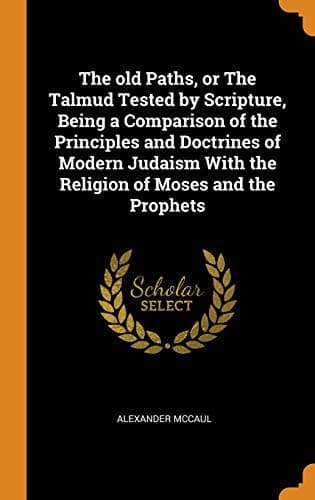
The old paths, or the Talmud tested by Scripture: Being a comparison of the principles and doctrines of modern Judaism with the religion of Moses and the prophetsMcCaul, Alexander
Religion
The old paths, or the Talmud tested by Scripture: Being a comparison of the principles and doctrines of modern Judaism with the religion of Moses and the prophets
McCaul, Alexander
Judaism -- Works to 1900
“Anything that a Gentile has lost is lawful, for it is said, ‘With all
lost things of _thy brother’s_.’ (Deut. xxii. 3.) And he that restores
it transgresses a transgression, for he strengthens the hands of the
wicked of the world. But if he restore it in order to sanctify the Name,
that they may think well of Israel, and know that they are honest
people, this is praiseworthy.” In these passages (and many more might be
added if it were necessary) it is plainly taught that an idolatrous
Gentile is not to be regarded as “our neighbour,” or our brother. We
think, then, that we have fully proved that the Jewish deputies in
France, and the compilers of the Jewish Catechism in Bavaria, did not
learn their exposition of the command, “Thou shalt love thy neighbour as
thyself,” from the Talmud; neither in the particular passage which they
quote, nor from the general principles of the Talmudic system. We have
already stated our belief that they learned that exposition from the New
Testament, for there it is taught plainly and repeatedly. We quoted, in
proof, a parable spoken by the Lord Jesus Christ. We shall now add a few
more passages in confirmation.
As to _showing kindness_ to all our fellow-men, the New Testament
teaches us to make no exception with regard to idolaters, or others who
have not the same creed, but gives the following general rules:—“As we
have, therefore, opportunity, let us do good UNTO ALL MEN, especially
unto them that are of the household of faith.” (Gal. vi. 10.) “See that
no man render evil for evil UNTO ANY MAN; but ever follow that which is
good both among yourselves, and TO ALL MEN.” (1 Thess. v. 15.) “The Lord
make you to increase and abound IN LOVE one toward another, and TOWARD
ALL MEN.” (1 Thess. iii. 12.) You observe that in these general rules
the New Testament makes no reservation with respect to idolaters, or
epicureans, or heretics, or any other of those unfortunate beings whom
the Talmud outlaws from all the common charities of humanity. It
commands us to do good to _all_—and that not to avoid enmity, nor for
the sake of the ways of peace, nor because we are afraid, nor because we
wish them to speak well of us, and to be thought honest people, but
because it is our duty. The New Testament requires of its followers, not
only to abstain “from active violence” in injuring them, but to do
active good in assisting them, and the examples, which it proposes for
our imitation, are of the same character as the precepts which it
imposes upon our obedience. It sets before us Jesus of Nazareth, whom
the traditionists crucified, praying for his murderers, and saying,
“Father, forgive them; for they know not what they do”—and Stephen, his
first martyr, interceding for them that stoned him, “Lord, lay not this
sin to their charge.” And Paul, whose feelings to those who differed
from him in religion are thus expressed, “Brethren, my heart’s desire
and my prayer to God for Israel is, that they may be saved.” It sets
Public-domain text, read in full here on John Shaqi.
Reviews
Reviews
No reviews yet
Be the first to share your thoughts on this work.
Join the Discussion
Join the discussion
Sign in to leave a comment or review.
Sign InorCreate an account