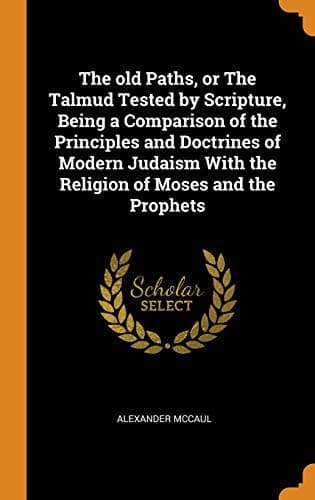
The old paths, or the Talmud tested by Scripture: Being a comparison of the principles and doctrines of modern Judaism with the religion of Moses and the prophets — John Shaqi
The old paths, or the Talmud tested by Scripture: Being a comparison of the principles and doctrines of modern Judaism with the religion of Moses and the prophetsMcCaul, Alexander
Religion
The old paths, or the Talmud tested by Scripture: Being a comparison of the principles and doctrines of modern Judaism with the religion of Moses and the prophets
McCaul, Alexander
Judaism -- Works to 1900
“The reading of the Megillah (the book of Esther) in its time is an
affirmative precept according to the words of the scribes, and it is
known that this is an ordinance of the Prophets. The obligation to read
it rests upon all, men, women, and proselytes, and manumitted slaves.
Children also are to be accustomed to the reading of it. Even priests in
their service are to neglect their service, and to come to hear the
reading of the Megillah. In like manner the study of the law is to be
omitted, in order to hear the reading of the Megillah, and _a fortiori_
all the remaining commandments of the law, all of which give way to the
reading of the Megillah: but there is nothing to which the reading of
the Megillah gives way, except that particular class of dead person
called the dead of the commandment, who has none to bury him. He that
happens upon him is first to bury him, and afterwards to read.”
(Hilchoth Megillah, c. i. 1.) On this extract we have several remarks to
make, but at present we request the attention of our readers to the
reason given why the reading of the Megillah is more important than any
of the commandments. It is this. According to the oral law, “the study
of the law is equivalent to all the commandments, and the other
commandments are to give way to this study.” But according to the
passage before us, the study of the law is to give way to the reading of
the Megillah. The reading of the Megillah, therefore, being greater than
the greatest of the commandments, is of course greater than all the
inferior ones. Now apply this reasoning to the above command to get
drunk, and you will prove that getting drunk at Purim feast is the
greatest of all the commandments. In order to get drunk, it is plain
that the study of the law must give way. The man who cannot distinguish
between “Cursed be Haman and blessed be Mordecai,” certainly cannot
study, neither can he bury the dead. The commandment, therefore, to
which the study of the law and the burying of the dead give way, must be
the greatest of all the commandments; _i.e._, the getting drunk on Purim
is the greatest of all the commandments. This conclusion, which
inevitably follows upon Talmudic principles, necessarily shows that
those principles are false. But that is not the object for which I have
exhibited this conclusion; it is with reference to the case of Rabba
above-mentioned. Having got drunk according as the oral law commanded,
and having thereby obeyed the greatest of the commandments, and one to
which all others are necessarily in abeyance, was he guilty or innocent
in having murdered R. Zira? It certainly seems a very hard case to
condemn him to death for an act, which resulted from his obedience to
the greatest of all the commandments. He might urge that he had a great
dislike to drunkenness—that he had overcome his natural aversion simply
to satisfy the Rabbinical requirements—that by the time that he had
Public-domain text, read in full here on John Shaqi.
Reviews
Reviews
No reviews yet
Be the first to share your thoughts on this work.
Join the Discussion
Join the discussion
Sign in to leave a comment or review.
Sign InorCreate an account