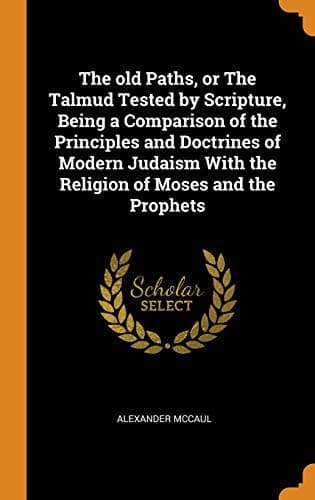
The old paths, or the Talmud tested by Scripture: Being a comparison of the principles and doctrines of modern Judaism with the religion of Moses and the prophetsMcCaul, Alexander
Religion
The old paths, or the Talmud tested by Scripture: Being a comparison of the principles and doctrines of modern Judaism with the religion of Moses and the prophets
McCaul, Alexander
Judaism -- Works to 1900
The book of Esther appears to have been a peculiar favourite of the
Rabbies. The reading of it takes precedence of all other duties but one,
and is considered as obligatory, even upon the women, who are declared
exempt from the study of the law. It is true that it contains a very
notable warning for disobedient wives, and a striking instance of the
deliverance of Israel by the instrumentality of a woman; but when we
consider that the name of God does not occur once in the whole book, and
that the law contains the account of man’s creation and fall, the ten
commandments, the deliverance from Egypt, and all those events of
primary interest to women as well as men, it becomes of some importance
to consider why the women, who are not bound to study the law of God,
are bound to read the book of Esther. The authors of the oral law appear
to have attached uncommon importance to this book, as appears from this
circumstance, and still more so from the following startling declaration
of Maimonides:—
כל ספרי הנביאים וכל הכתובים עתידן ליבטל לימות המשיח חוץ ממגלת אסתר ,
והרי היא קיימת כחמשה חומשי תורה וכהלכות של תורה שבעל פה שאינן לעולם ׃
“All the books of the prophets, and all the Hagiographa, except the roll
of Esther, will cease in the days of Messiah. But it is perpetual as the
five books of the written law, and the constitutions of the oral law,
which shall never cease.” (Hilchoth Megillah.) Some of the Rabbies say
that this is to be taken conditionally, “although they were all to
cease, yet this would not cease.” But this still attributes a decided
superiority to the book of Esther above all the other books. What then
is there in it, that gives this book such a peculiar favour, and makes
the history of Esther more important than that of the conquest of
Canaan, or of the glory of Solomon, or of the restoration of the house
of the Lord? Is there more devotion and piety to be found in it than in
the Psalms of David? Does it contain more wisdom than the Proverbs of
Solomon? Is there a sublimer flight of Divine poetry, a more heavenly
afflatus than in the visions of Isaiah? A more open revelation of the
mysteries of the Deity than is to be found in Job, or Daniel, or
Ezekiel? Why do the Rabbies pronounce it worthy of preservation, whilst
they contemplate without emotion the loss of all the other books? We
cannot possibly discover, unless it be that it furnishes more
gratification to the spirit of revenge so natural to all the children of
Adam, whether they be Jew or Gentile. To forgive is to be like God—and
God alone can teach forgiveness either speculatively or practically. But
the book of Esther contains an account of the revenge which the Jews
took upon their enemies, not like the destruction of the Canaanites,
fulfilling the commands of God upon His enemies, but taking personal and
individual revenge on their own. And this very fact may be one reason
why God did not permit his most holy name to occur in the whole
Public-domain text, read in full here on John Shaqi.
Reviews
Reviews
No reviews yet
Be the first to share your thoughts on this work.
Join the Discussion
Join the discussion
Sign in to leave a comment or review.
Sign InorCreate an account