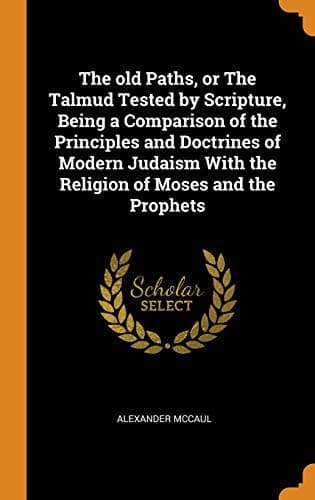
The old paths, or the Talmud tested by Scripture: Being a comparison of the principles and doctrines of modern Judaism with the religion of Moses and the prophets — John Shaqi
The old paths, or the Talmud tested by Scripture: Being a comparison of the principles and doctrines of modern Judaism with the religion of Moses and the prophetsMcCaul, Alexander
Religion
The old paths, or the Talmud tested by Scripture: Being a comparison of the principles and doctrines of modern Judaism with the religion of Moses and the prophets
McCaul, Alexander
Judaism -- Works to 1900
The noblest inquiry, to which the mental powers can be directed, is,
Which religion comes from God? The most satisfactory mode of conducting
such an inquiry, independently of the external evidence, is to compare
the principles of one system with those of the other, and both with an
acknowledged standard, if such there be, and this is what we are
endeavouring to do in these papers. We by no means wish to make the
modern Jews responsible for the inventions of their forefathers, but to
show them that their traditional argument for rejecting Christianity,
and that is the example of the high priest and the Sanhedrin, is of no
force; inasmuch as these same persons, who originally rejected Jesus of
Nazareth, were in great and grievous error in the fundamental principles
of religion, whilst He who was rejected taught the truth. To do this we
must appeal to the oral law, and discuss its merits. We have shown
already that those persons did not understand at least one half of the
law; that their doctrines were in the highest degree uncharitable. It
has, however, been replied, that the Talmud is more tolerant than the
New Testament, for it allows “that the pious of the nations of the world
may be saved;” whereas the latter asserts that “whosoever believeth not
shall be damned.” We must, therefore, inquire into the extent of
toleration and charity contained in that Talmudic sentence. The first
step in this inquiry, is to ascertain who are the persons intended in
the expression “The pious of the nations of the world.” The oral law
tells us, as quoted in No. 6, that the Israelites are commanded to
compel all that come into the world to receive the seven commandments of
the sons of Noah, and adds,
והמקבל אותם הוא הנקרא גר תושב בכל מקום ׃
“He that receives them is called universally a sojourning proselyte.”
And a little lower down it says plainly
כל המקכל שבע מצוות ונזהר לעשותן הרי זה מחסידי אומות העולם , ויש לו חלק
לעולם הבא ׃
“Whosoever receives the seven commandments, and is careful to observe
them, he is one of the pious of the nations of the world, and has a
share in the world to come.” (Hilchoth Melachim, c. viii. 10.) From
these two declarations, then, we learn that “the pious of the nations of
the world” are the same, as “the sojourning proselytes,” who were
allowed to reside in the land of Israel, and that their piety consisted
in receiving and practising the seven commandments. What these
commandments were, we are informed in the next chapter of the same
treatise.
על ששה דברים נצטוה אדם הראשון , על ע׳׳ז , ועל ברכת השם , ועל שפיכת דמים
, ועל גלוי עריות , ועל הגזל , ועל הדינים , אף על פי שכולן הן קבלה בידנו
ממשה רבינו , והדעת נוטה להן , מכלל דברי תורה יראה שעל אלה נצטוה , הוסיף
לנח אבר מן החי שנאמר אך בשר בנפשו דמו לא תאכלו , נמצאו שבע מצוות , וכן
היה הדבר בכל העולם עד אברהם ׃
Public-domain text, read in full here on John Shaqi.
Reviews
Reviews
No reviews yet
Be the first to share your thoughts on this work.
Join the Discussion
Join the discussion
Sign in to leave a comment or review.
Sign InorCreate an account