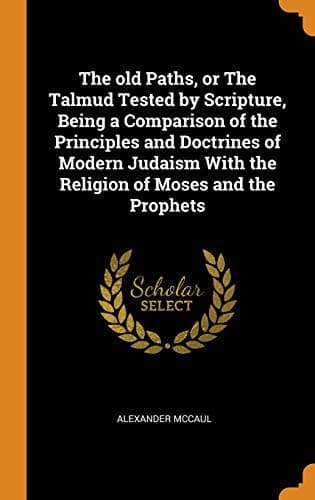
The old paths, or the Talmud tested by Scripture: Being a comparison of the principles and doctrines of modern Judaism with the religion of Moses and the prophetsMcCaul, Alexander
Religion
The old paths, or the Talmud tested by Scripture: Being a comparison of the principles and doctrines of modern Judaism with the religion of Moses and the prophets
McCaul, Alexander
Judaism -- Works to 1900
“We have explained long ago, that the washing and bathing of the hands
are derived from the words of the scribes.” (Hilchoth Mikvaoth, xi. 1.)
That they had no Divine authority for the command is evident from the
subtilty and superstition of its ordinances; for we presume that few
will question the superstition of the threat of blindness to the
disobedient, or of the fable of the evil spirit resting upon the hands.
One such command, then, will go far to discredit the whole story of an
oral law, and to invalidate the character of its witnesses. They were
evidently superstitious men, no way elevated above the vulgar prejudices
or the times, not at all scrupulous in adding to the law of God, and
evidently aiming at a complete domination over the consciences of their
followers. It is hardly possible to believe that they were not aware of
the necessary result of the system, the complete subjugation of the
consciences of the multitude. The mass of mankind has no leisure for the
study of juristic distinctions, they must, therefore, if they believe
such to be Divine, cast themselves upon the mercy of the learned, and
there can be no doubt that those who have the keys of salvation, will
also possess no small degree of influence and power in this world. But,
whatever was the motive, there can be no doubt about the severity with
which the Rabbies enforced this command. They exacted even from the poor
unfortunate, whom circumstances left only enough water to slake his
thirst, that he should sacrifice a port of it to this Rabbinical
purification.
אפילו אין לו מים אלא כדי שתייה נוטל ידיו במקצתן ואח׳׳כ אוכל ושותה מקצתו
׳
“Though he should only have enough water to drink, he is to wash his
hands with a part of it, and then to eat, and to drink the remainder.”
(Hilchoth Berachoth, vi. 19.) And not content with this harsh
requirement, they sentence the despiser of their commands to
excommunication.
וצריך ליזהר בנטילת ידים שכל המזלזל בנטילתם חייב נדוי ׳
“It is necessary to be very careful in washing of hands, for every one
who despises the washing of hands is guilty of excommunication.” (Orach
Chaiim., § 158.) And this same book confirms this decision by a case
which actually occurred of a man thus excommunicated, and who dying in
his excommunication had the usual indignities offered to his corpse.
את מי נדו את אלעזר בן חצר שפקפק בנטילת ידים וכשמת שלחו בית דין והניחו
אבן גדולה על ארונו ללמדך שכל המתנדה ומת בנדויו בית דיו סוקלין את ארונו ׃
“Whom did they excommunicate? Eleazar ben Chatzar, who despised the
washing of hands; and when he was dead, the tribunal sent, and had a
great stone laid on his coffin, to teach thee that of every one who is
excommunicated and dies in his excommunication, the coffin is stoned by
the tribunal.” (Talmud, Berachoth, fol. 19, col. 1.) When they had the
power they employed it to the full, and now that they have it not, the
oral law still threatens poverty and extirpation to every transgressor.
Public-domain text, read in full here on John Shaqi.
Reviews
Reviews
No reviews yet
Be the first to share your thoughts on this work.
Elsewhere in the archive
Join the Discussion
Join the discussion
Sign in to leave a comment or review.
Sign InorCreate an account