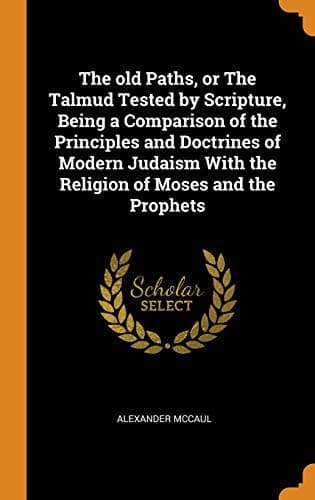
The old paths, or the Talmud tested by Scripture: Being a comparison of the principles and doctrines of modern Judaism with the religion of Moses and the prophetsMcCaul, Alexander
Religion
The old paths, or the Talmud tested by Scripture: Being a comparison of the principles and doctrines of modern Judaism with the religion of Moses and the prophets
McCaul, Alexander
Judaism -- Works to 1900
This year, the Jewish and the Christian times for celebrating the Feast
of the Passover nearly coincide; and the coincidence ought to remind us
both of that happy period, when all the children of man, so long
divided, shall again be united into one great, holy, and happy family;
all rejoicing in the mercy and favour of their Heavenly Father, and all
loving each other in sincerity and truth. To that period we look
forward, and even now we use our humble endeavours to accelerate its
approach. Yea, one of the reasons, why we endeavour to lead Israel to a
rejection of the oral law, is because we firmly believe that it is one
of the main hindrances in the way of their happiness and that of the
nations of the world. We have no wish to rob you of any one blessing
promised in the Word of God. We would not deprive you of one hope
founded upon God’s promises. On the contrary, we rejoice to think that
notwithstanding all the vain traditions of the Scribes and Pharisees, it
has pleased God to keep alive in your hearts the memory of his past
mercy, and the hope of his future goodness. To the consideration of
these two points, the law of Moses and your appointed prayers lead you
at this season, and through the mercy of God, and the love of some of
your brethren, we of the Gentiles have been brought to rejoice in
similar considerations. Let us then endeavour to anticipate the future,
and rejoice together even now, omitting on this solemn occasion a
special discussion of the oral law. If God’s mercy were all past, and
only a matter of history, we might and ought to feel grateful for the
benefits bestowed upon our fathers: our joy would, however, suffer a
considerable diminution. But this is not the case. In the midst of your
grateful acknowledgment for the wonders in Egypt, you can mingle a
prayer for the future, and say,
לשנה הבאה בירושלים ׃
“Next year in Jerusalem.”
רחם נא י׳׳י אלהינו על ישראל עמך ועל ירישלים עירך ועל מזבחך ועל היכלך ,
ובנה ירושלים עיר הקודש במהרה בימינו והעלנו לתוכה ושמחנו בה ׃
“O Lord our God, have mercy, we beseech thee, upon Israel thy people,
and upon Jerusalem thy city, and upon thine altar, and upon thy temple;
and build Jerusalem, the holy city, speedily, in our days, and bring us
up into the midst of it, and make us glad therein.” (Haggadah Shel
Pesach.) And to this prayer we can say, “Amen” with all our hearts. The
future restoration and blessedness of Israel is one of our fondest
expectations; and whilst we contemplate the circumstances and the glory
of the first Exodus, the Word of the living God leads us to look forward
to that which is to come.
כימי צאתך מארץ מצרים אראנו נפלאות ׃
“According to the days of thy coming out of the land of Egypt will I
show unto him marvellous things,” is the promise by the mouth of Micah
the prophet (c. vii. 10).
והחרים יהוה את לשון ים מצרים והניף ידו על הנהר בעים רוחו והכהו לשבעה
נחלים והדריך בנעלים , והיתה מסלה לשאר עמו אשר ישאר מאשור כאשר היתה
לישראל ביום עלותו מארץ מצרים ׃
Public-domain text, read in full here on John Shaqi.
Reviews
Reviews
No reviews yet
Be the first to share your thoughts on this work.
Elsewhere in the archive
Join the Discussion
Join the discussion
Sign in to leave a comment or review.
Sign InorCreate an account