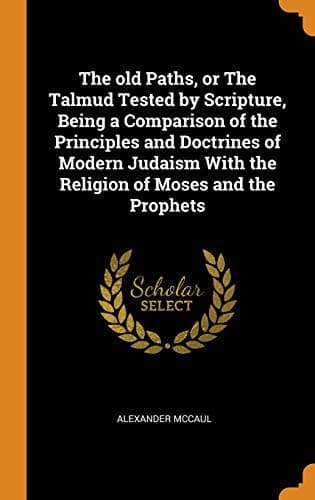
The old paths, or the Talmud tested by Scripture: Being a comparison of the principles and doctrines of modern Judaism with the religion of Moses and the prophetsMcCaul, Alexander
Religion
The old paths, or the Talmud tested by Scripture: Being a comparison of the principles and doctrines of modern Judaism with the religion of Moses and the prophets
McCaul, Alexander
Judaism -- Works to 1900
“And the Lord shall utterly destroy the tongue of the Egyptian sea, and
with his mighty wind shall he shake his hand over the river, and shall
smite it in the seven streams, and shall make men go over dry shod. And
there shall be a highway for the remnant of his people, which shall be
left from Assyria; like as it was to Israel in the day that he came up
out of the land of Egypt,” is the declaration of the Prophet Isaiah (xi.
15, 16). Seeing that neither of these declarations was fulfilled at the
return from Babylon, nor at any period since, we firmly believe that
they shall be fulfilled in the time to come, and that therefore the
compilers of the Haggadah were fully warranted in intermingling, with
their Passover thanksgivings, a prayer for the fulfilment of the
promised mercies; and we do not scruple to say that in this respect, the
Jewish Rabbies have been right, whilst many Christian interpreters have
been wrong; though they might have known and given a true explanation of
all similar passages, if they had only followed the plain words of their
master, Jesus of Nazareth, “Think not that I am come to destroy the law
or the prophets.” (Matt. v. 17.) We make this remark to show that we do
not condemn the Rabbies inconsiderately; but that we are willing to do
them all justice, where their opinions agree with the Word of God. Their
expectation of the future restoration of Israel is well founded, and
their faith in the promises relating to it worthy of all imitation. Oh,
that the whole nation had more of it—that their hearts were more
directed to the land of their forefathers—that their thoughts were more
full of the Divine promises. Then they would cry more earnestly to God,
and He would “hear their groaning, and remember his covenant with
Abraham, Isaac, and Jacob,” as he did at the deliverance from Egypt. The
careless and the ungodly deceive themselves with the idea, that when
God’s time comes, the deliverance will take place without any endeavour
of theirs. Let them read the law of Moses, and they will find that
though God had promised to bring their fathers out of Egypt, the
deliverance itself was preceded by a time of prayer and crying unto God.
To Abraham he had said,
ידוע תדע כי גר יהיה זרעך בארץ לא להם ועבדום וענו אותם ארבע מאות שנה ...
ודור רביעי ישובו הנה וגו׳ ׃
“Know of a surety that thy seed shall be a stranger in a land that is
not theirs, and shall serve them; and they shall afflict them four
hundred years.... But in the fourth generation they shall come hither
again,” &c. (Gen. xv. 13, 16.) But this promise was no warrant for their
remaining careless, and at ease; it was on the contrary a basis for
earnest prayer and supplication, and a plea for mercy. And, therefore,
when the time drew near, we read,
יואנחו בני ישראל מן העבודה ויזעקו ותעל שועתם אל האלהים מן העבודה ׃
Public-domain text, read in full here on John Shaqi.
Reviews
Reviews
No reviews yet
Be the first to share your thoughts on this work.
Elsewhere in the archive
Join the Discussion
Join the discussion
Sign in to leave a comment or review.
Sign InorCreate an account