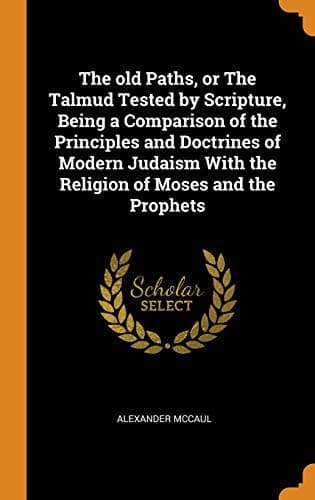
The old paths, or the Talmud tested by Scripture: Being a comparison of the principles and doctrines of modern Judaism with the religion of Moses and the prophetsMcCaul, Alexander
Religion
The old paths, or the Talmud tested by Scripture: Being a comparison of the principles and doctrines of modern Judaism with the religion of Moses and the prophets
McCaul, Alexander
Judaism -- Works to 1900
“Hear, O my people, and I will speak; O Israel, and I will testify
against thee: I am God, even thy God. I will not reprove thee for thy
sacrifices or thy burnt offerings, to have been continually before me. I
will take no bullock out of thy house, nor he goats out of thy folds.”
Here God plainly excepts the offerings of bulls and goats, and thereby
overthrows the exposition of Rashi and others, who say that the covenant
and sacrifices here alluded to are the same as those described at the
giving of the law, when Moses said, “Behold the blood of the covenant,”
&c. (Exod. xxiv. 8.) The sacrifices then offered were “burnt-offerings
and peace-offerings of oxen,” which God here declares that he will not
accept. Besides, God is not speaking of many sacrifices, but of one
sacrifice אלי זבח . He is moreover speaking of one great sacrifice, by
virtue of which sinful men may stand before him as saints at the great
day of judgment, and obtain mercy. This certainty cannot mean the
sacrifices of the Mosaic covenant at Sinai, for by reason of that
sacrifice, they will appear as guilty sinners who have broken God’s
covenant, as he himself says—
אשר המה הפרו את ברית ׃
“Which my covenant they brake.” (Jer. xxxi. 32.) At that solemn hour the
Mosaic covenant will only condemn, and therefore cannot be meant here.
Indeed the rabbies appear to have felt the untenableness of this
exposition, and therefore invented another figurative one—
ויש דרש כי על ברית מילה שהחזיקו בה ישראל בגלות ׃
“There is also an allegorical interpretation referring it to the
covenant of circumcision, which Israel has faithfully adhered to in the
captivity.” (Kimchi, in loc.) But this exposition is as unfounded as the
former. Circumcision is never called a sacrifice in Scripture. Neither
will it serve a man in the day of judgment. What then is the sacrifice
which is here intended? We answer, the true Passover, the blood of the
Messiah, whereby the new covenant is ratified. Some object that the
shedding of blood is altogether unnecessary—that if God will forgive at
all, he can forgive without atonement or sacrifice. But this objection
will equally affect the sacrifice of the first Passover. On the very
same grounds, we may say, What necessity was there for killing a lamb,
and sprinkling its blood upon the door-posts? The directions given by
Moses are very striking—“Kill the passover. And ye shall take a bunch of
hyssop, and dip it in the blood that is in the bason, and strike the
lintel and the two side posts with the blood that is in the bason; and
none of you shall go out at the door of his house until the morning. For
the Lord will pass through to smite the Egyptians; and when he seeth the
blood upon the lintel, and on the two side posts, the Lord will pass
over the door, and will not suffer the destroyer to come in unto your
houses to smite you.” (Exod. xii. 21-23.) Surely the blood was not
necessary to make known to him which house belonged to an Israelite. He
Public-domain text, read in full here on John Shaqi.
Reviews
Reviews
No reviews yet
Be the first to share your thoughts on this work.
Elsewhere in the archive
Join the Discussion
Join the discussion
Sign in to leave a comment or review.
Sign InorCreate an account