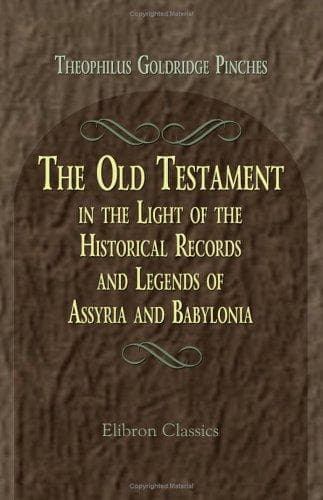
The Old Testament in the Light of the Historical Records and Legends of Assyria and BabyloniaPinches, Theophilus G. (Theophilus Goldridge)
Religion
The Old Testament in the Light of the Historical Records and Legends of Assyria and Babylonia
Pinches, Theophilus G. (Theophilus Goldridge)
Bible. Old Testament -- Criticism, interpretation, etc.
When the enclosure of Ê-zida (the great temple-tower of Borsippa,
identified with the tower of Babel by modern scholars) was broken down,
Ibi-Tutu, apparently a Babylonian prince, fled to Tiamtu, the region of
the Persian Gulf, and there founded a temporary capital. The invader
thereupon seems to have proceeded to Borsippa, and to have taken the road
to Mesech—that is to say, to the north—where he continued his ravages.
That he intended to go so far as Mesech, however, is very unlikely, his
object being to subdue the princes of the immediate neighbourhood of
Babylon, and after collecting the spoil and goods of all the temples, he
carried them away with him to Elam.
Cyrus, when he entered Babylon, spoke peace to the city, and promised
peace to all the land. In later documents even than the time of Cyrus,
“the enemy, the Elamite,” is spoken of, and there is every probability
that the legend here recounted was popular with the Babylonians as long as
any national feeling was left, hence these incomplete remains which have
come down to us—due, perhaps, to some period when the old hostility was
aroused by some inroad from the mountains on the east, where the Elamites
held sway apparently to a comparatively late date.
Whether Êri-Eaku (or Eri-Aaku), Tudḫula, and Kudur-laḫgumal be Arioch,
Tidal and Chedorlaomer respectively, I leave to the reader to decide for
himself. The first of these will probably be regarded as sufficiently near
to be exceedingly probable. With regard to the two others, it may be noted
that Tidal was pronounced, in Hebrew, Tidghal, as the Greek Thargal (for
Thadgal, _d_ and _r_ being so much alike in Hebrew as to be easily
interchanged) shows, and Chedorlaomer was Chedorlaghomer, as the Greek
Chodollogomar likewise indicates. Doubt concerning the reading can only be
entertained with regard to this last name.(48)
Public-domain text, read in full here on John Shaqi.
Reviews
Reviews
No reviews yet
Be the first to share your thoughts on this work.
Elsewhere in the archive
Join the Discussion
Join the discussion
Sign in to leave a comment or review.
Sign InorCreate an account