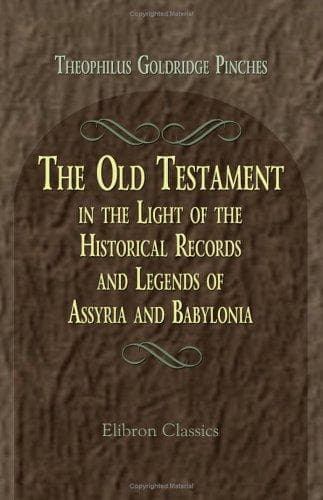
The Old Testament in the Light of the Historical Records and Legends of Assyria and BabyloniaPinches, Theophilus G. (Theophilus Goldridge)
Religion
The Old Testament in the Light of the Historical Records and Legends of Assyria and Babylonia
Pinches, Theophilus G. (Theophilus Goldridge)
Bible. Old Testament -- Criticism, interpretation, etc.
“O lord, if Arzauia of the city of Ruḫizzu and Teuwatti of the city Lapana
remain in the land of Ube, and Daša remain in the land of Amki, then may
my lord know concerning them, that the land of Ube is not my lord’s. They
send to Aiṭugama every day saying thus: ‘Come and take the land of Ube
completely.’
“O lord, as the city Timašgi in the land of Ube is at thy feet, so also is
the city Qaṭna at thy feet. And, my lord, with regard to my messenger, I
ask for life, (and a)s I do not fear with regard to the field-troops of my
lord, that the field-troops of my lord will come, as he will send (them)
forth to me, I shall re(tire) into the city Qaṭna.”
Thus the trouble spread, and the Hittites and their allies took possession
of the territories south of the tracts referred to, trying, at the same
time, to win over to their side the governors who were faithful. All this
time posing as a friend of the Pharaoh, Etagama complained of the others,
particularly Namya-waza, one of Egypt’s most trustworthy allies, who, in a
letter couched in the usual humble style of the period, announces his
readiness to serve “with his horses and chariots, and with his brothers,
and with his SA-GAS, and with his Sutites, along with the hired soldiers,
whithersoever the king his lord should command him.”
Now in this letter there is one noteworthy fact, and that is, that the
SA-GAS and the Sutites are mentioned together as the allies of an
important vassal of the Egyptian king, the latter being apparently
wandering hordes of plunderers (see above, p. 283), whom Kadašman-Muruš,
king of Babylonia, sent from east to west “until there were no more.” This
took place at a somewhat later date, so that they still roamed about the
eastern portion of the country, between Palestine and Babylonia,
apparently giving their services to any power which might desire to make
use of them.
Public-domain text, read in full here on John Shaqi.
Reviews
Reviews
No reviews yet
Be the first to share your thoughts on this work.
Elsewhere in the archive
Join the Discussion
Join the discussion
Sign in to leave a comment or review.
Sign InorCreate an account