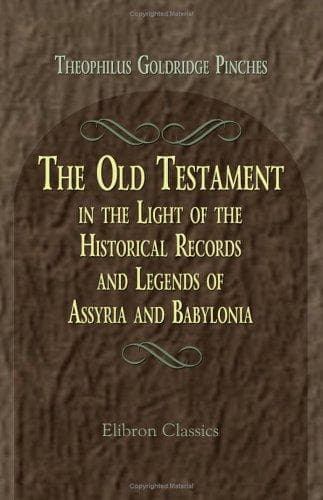
The Old Testament in the Light of the Historical Records and Legends of Assyria and BabyloniaPinches, Theophilus G. (Theophilus Goldridge)
Religion
The Old Testament in the Light of the Historical Records and Legends of Assyria and Babylonia
Pinches, Theophilus G. (Theophilus Goldridge)
Bible. Old Testament -- Criticism, interpretation, etc.
The explanation is very simple, and remarkably conclusive in its way.
Merodach, in the legend of the Creation, there appears as the greatest
hunter (using the word in the Hebrew sense of “entrapper”) that ever
lived. For did he not, when Tiamtu, the great dragon of chaos and
disorder, tried to usurp the dominion of the gods, and bring ruin on their
fair work, chase and entrap her, thereby winning the throne of the kingdom
of heaven, and laying the universe under an everlasting debt to him? With
his net he caught and held her fast, and, standing on her body, slew her.
This was the feat of a real _gibbor ṣayid_, a “hero in hunting,” or
entrapping with a net, for _ṣayid_, “hunting,” is from the same root as
Sidon, the name of the ancient “fishing town,” renowned of old, and still
existing at the present day.
The Tower Of Babel.
There is no doubt that one of the most striking and attractive episodes of
the sacred narrative of Genesis is the Tower of Babel. It has attracted
the attention of all from its circumstantial details, and has, as an
authoritative narrative, had the full belief of all the faithful for many
thousand years. This being the case, it is needful to go rather carefully
into the matter, not only to try to account for its origin, but also to
satisfy the believer of to-day with regard to the story being a real
historical fact.
“Of these were the isles of the Gentiles divided in their lands,”—“These
are the sons of Ham, after their families,”—“These are the sons of Shem,
after their families,” says the author of Genesis in ch. x. 5, 20, and 31,
and then he adds, in slightly varying words, “after their tongues, in
their lands, in their nations.”
Yet, after this (ch. xi. 1) we have the statement, “And the whole earth
was of _one_ language, and of _one_ speech.” Moreover, how was it possible
that the whole of the nations of the earth there enumerated in the tenth
chapter should have had their origin at Babel, the beginning of Nimrod’s
(Merodach’s) kingdom, coeval with Erech, Akkad, and Calneh, in the land of
Shinar? The effect of such a statement as this would surely be to make the
language of Nimrod the primitive language of the world, unless, indeed,
all the languages of the earth resulting from the confusion of tongues
were regarded as new, the primitive speech of man having been destroyed on
that occasion. Then, again, as we know, the building of the city was not
stopped, for it continued until it became the greatest and most important
centre in the known world when it was at the height of its glory.
Public-domain text, read in full here on John Shaqi.
Reviews
Reviews
No reviews yet
Be the first to share your thoughts on this work.
Elsewhere in the archive
Join the Discussion
Join the discussion
Sign in to leave a comment or review.
Sign InorCreate an account