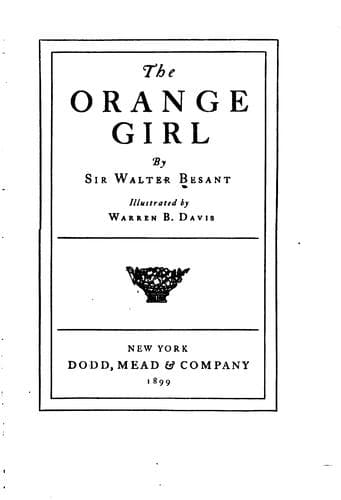
London (England) -- History -- 18th century -- Fiction
So he stood down. The Captain was called by the name he gave
himself--Ferdinando Fenwick. He said he had never been known by any
other name, that he had no knowledge of the name of Tom Kestever. He had
never heard that name. Nor did he know of any occasion on which the said
Tom Kestever had been ducked for a pickpocket: flogged for a rogue:
imprisoned and tried on a capital charge for cattle lifting. Oh! Jenny,
the case was well got up, truly. He, too, had never heard of the Black
Jack, and stoutly stood it out that he was a gentleman of Cumberland.
Asked what village or town of Cumberland, he named Whitehaven as the
place in which he was born and had his property--to wit, five farms
contiguous to the town and two or three messuages in the town.
When this evidence was concluded a juryman rose and asked permission of
the Court to put a question to the witness, which was granted him.
'Those farms,' he said, 'are contiguous to Whitehaven? Yes, and you were
born in that town? What was your father by occupation?'
'He was a draper.'
'My lord,' said the Juryman, 'I am myself a native of Whitehaven. I am
the son of the only draper in the town. I am apparently about the same
age as the witness. I have never seen him in the town. There is no
reputable tradesman of that name in the town, or anywhere near it. There
are gentlefolk of the name, but in Northumberland.'
'I wish, Sir,' said the Counsel, 'that I had you in the box.'
'The statement of a Juryman is not evidence,' the Prosecuting Counsel
interposed.
'I fear, my learned brother,' said the Judge, 'that when the Jury
retire, it will become a strong piece of evidence, whatever direction I
may give them.'
The Serjeant declined to re-examine this evidence.
Then my counsel called Mr. Merridew, who very reluctantly got into the
box again.
He denied solemnly that he knew either of the preceding witnesses. He
denied that he knew the Black Jack. He owned, with a pretence at pride,
that he had frequently served his country by informing against rogues
and had taken the reward to which he was entitled. He denied that he
encouraged young fellows to become highwaymen in hopes of securing the
higher reward. He denied that he knew Mr. Probus. He swore that he
should not benefit by the conviction of the prisoner.
You observe that the object of the Counsel was to make everyone plunge
deeper into the mire of perjury. His case was strong indeed, or he would
not have followed this method.
Public-domain text, read in full here on John Shaqi.
Reviews
Reviews
No reviews yet
Be the first to share your thoughts on this work.
Elsewhere in the archive
Join the Discussion
Join the discussion
Sign in to leave a comment or review.
Sign InorCreate an account