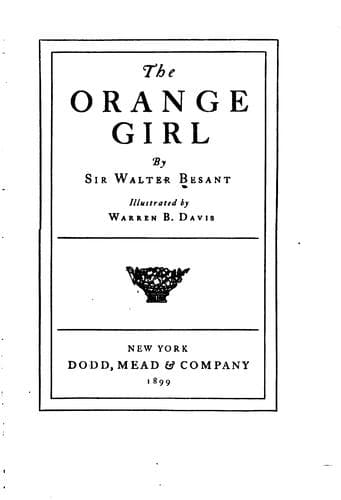
London (England) -- History -- 18th century -- Fiction
XXII FROM THE CONDEMNED CELL 295
XXIII AN UNEXPECTED EVENT 308
XXIV COMMUTATION 316
XXV TRANSPORTATION 322
XXVI THE LAST TEMPTATION 336
PROLOGUE
On a certain afternoon in May, about four or five of the clock, I was
standing at the open window of my room in that Palace to which Fortune
leads her choicest favourites--the College, or Prison, as some call it,
of the King's Bench. I was at the time a prisoner for debt, with very
little chance of ever getting out. More fortunate than most of the
tenants, I was able to carry on my business. For instance, all that
morning I had been engaged in composing a song--it was afterwards sung
with great applause at the Dog and Duck; and on the bed reposed the
instrument with which I earned the greater part of my daily bread--my
faithful violin.
My window was on the ground-floor in the great building which was then
new, for the Prison had been transferred from the other side two or
three years before. This building contains more than two hundred rooms,
and twice that number of prisoners. Many of the ground-floor rooms have
been converted into shops--chandlers', grocers', mercers', hosiers'. You
may buy anything in these shops, except a good book. I believe that
there is no demand in the prison for such an article of commerce.
Song-books and jest-books and cards on the other hand, are constantly
called for. It was a day of bright sunshine. Outside, on the Grand
Parade--otherwise called King Street--which is a broad footway flagged,
strolled up and down in the sunshine an endless procession. They paced
the pavement from East to West; they turned and paced it again from West
to East. Among them were a few neatly attired, but by far the greater
number, men and women, were slatternly, untidy, and slipshod. Their
walk--nobody was ever seen to walk briskly in the Prison--was the
characteristic scuffle easily acquired in this place; the men were
mostly in slippers: some were in morning gowns: very few had their
heads dressed: some wore old-fashioned wigs, rusty and uncombed: some,
the poorer set, were bare-footed, and in such rags and tatters as would
not be tolerated in the open streets. The faces of the people as they
passed were various. There was the humorous face of the prisoner who
takes fortune philosophically: there was the face always resentful: the
face resigned: the face vacuous: the face of suffering: the face sodden
with drink: the face vicious: the face soured: the face saddened: the
face, like the clothes, ragged and ruined: everything but the face
happy--that cannot be found in the King's Bench Prison. Children ran
about playing and shouting: there were at this time many hundreds of
children in the prison. Against the wall--'tis surely twenty-five feet
Public-domain text, read in full here on John Shaqi.
Reviews
Reviews
No reviews yet
Be the first to share your thoughts on this work.
Join the Discussion
Join the discussion
Sign in to leave a comment or review.
Sign InorCreate an account