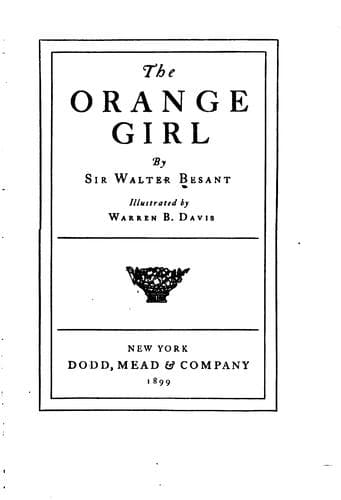
London (England) -- History -- 18th century -- Fiction
During the whole time of the trial the eyes of everybody in court, I
observed, were turned upon the prisoner. Never before, I am sure, did a
more lovely prisoner stand in the Dock: never was there one whose
position was more commiserated: they were all, I verily believe, ready
to set her free at once: but for the act and deed of the prisoner
herself. Her attitude: her face: her dress all proclaimed aloud the
words which I have written down above. Everybody had seen her on the
stage playing principally the coquette, the woman of fashion and folly,
the hoyden, the affected prude--but not a part like this. 'Ye gods!' I
heard a young barrister exclaim. 'She looks like an angel: an angel sent
down to Newgate!' The strange, new, unexpected look of virginal
innocence stamped on the brow of the once daring and headlong actress
startled the people: it went to the heart of everyone: it made everybody
present feel that they were assisting at a martyrdom: nay, as if they
were themselves, unwillingly, bringing faggots to pile the fire. Before
the trial began many an eye was dim, many a cheek was humid.
The Court entered: the people rose: the Counsel bowed to the Bench: the
Lord Mayor took his seat: beside him the Judge: with him the Aldermen
and the Sheriffs: the prisoner also did reverence to the Court like a
gentlewoman receiving company. One would not have been surprised had my
Lord Mayor stepped down and kissed her on the cheek in City fashion. But
neither in her look nor in her actions was there betrayed the least sign
of degradation, fear, or shame.
When a somewhat lengthy indictment had been read, she raised her head.
'My Lord, I would first desire to ask for my name to be amended.'
'What amendment do you desire?'
'I am described as Madame Vallance, alias Jenny Wilmot, actress. It is
true that Jenny Wilmot was my maiden name, and that I assumed the name
of Madame Vallance when I left the stage and opened the Assembly Rooms.
My true name is Jenny Halliday, and I am the wife of Mr. Matthew
Halliday, son of Sir Peter Halliday, Alderman, and partner in the House
of Halliday Brothers, West India Wharf, by the Steel Yard in the Parish
of All Hallows the Great.'
The Judge, whom nothing could surprise, answered with the awful coldness
which becomes a Judge and so terrifies a prisoner. 'There is no dispute
concerning identity. Plead in your married name, if you will.'
'Then, my Lord, I plead Guilty.'
She had done it, then. With a case so strong: with an assurance of
acquittal, she had pleaded Guilty. My heart sank. Yet I knew what she
would do. The Lord Mayor whispered the judge again.
'You are ignorant of law and procedure in Courts of Justice,' he said.
'I will allow you to withdraw that plea. Have you no Counsel?'
'I need none, my Lord. I plead Guilty.'
The people all held their breath. Then the 'Case of Clarinda' was true
after all.
'I am anxious,' the Judge went on, 'that you should have a fair trial.
Appoint a Counsel. Advise with him.'
Public-domain text, read in full here on John Shaqi.
Reviews
Reviews
No reviews yet
Be the first to share your thoughts on this work.
Elsewhere in the archive
Join the Discussion
Join the discussion
Sign in to leave a comment or review.
Sign InorCreate an account