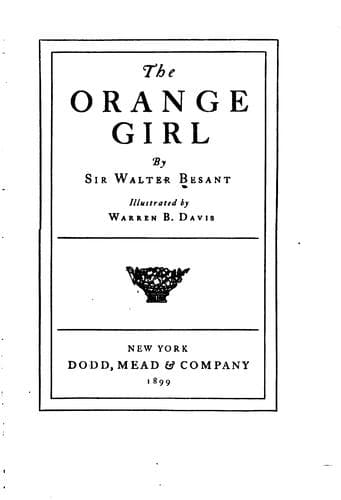
London (England) -- History -- 18th century -- Fiction
It was then about five o'clock. We went to a coffee-house and took some
coffee and ratafia. The animation of the place; the brisk conversation;
the running about of the boys: the fragrant odour of the coffee: pleased
us. There were coffee-houses in the High Street, but they lacked the
vivacity of this on Ludgate Hill, where Templars, Doctors of Divinity,
and the mercers and goldsmiths of Ludgate Hill and Fleet Street were
assembled together to talk and drink the fragrant beverage which has
done so much to soften the manners of the better sort.
'And now,' said Tom, 'for my surprise.'
He called a coach and we drove not knowing whither; he was taking us to
Drury Lane.
We were to celebrate our wedding-day by going to the Play.
For my own part I had never--for reasons which you will understand--been
allowed to go to the Play. To sober-minded merchants the Play was a
thing abhorrent: a hot-bed of temptation: the amusements of Prodigals
and Profligates. Therefore I had never seen the Play. Nor had Alice or
her sister-in-law, while Tom, who had once played in the orchestra, had
never seen the Play since his debts carried him off to the King's Bench.
We found good places in the Boxes: the House was not yet half full and
the candles were not all lighted: many of the seats were occupied by
footmen waiting for their mistresses to take them: in the Pit the
gentlemen, who seemed to know each other, were standing about in little
knots conversing with the utmost gravity. One would have thought that
affairs of state were being discussed: on the contrary, we were assured,
they were arguing as to the merits or the blemishes of the piece, now in
its third night.
Presently the musicians came in and the cheerful sound of tuning up
began: then the House began to fill up rapidly; and the orange girls
made their way about the Pit with their baskets, and walked about the
back of the boxes calling out their 'fine Chaney orange--fine Chaney
orange.' Why do I note these familiar things? Because they were not
familiar to me: because they are always connected in my mind with what
followed.
The play was 'The Country Girl.' The story is about an innocent Country
Girl, an heiress, who knows nothing of London, or of the world. Her
guardian wants to marry her himself for the sake of her money, though he
is fifty and she is twenty: as he cannot do so without certain papers
being drawn up, he makes her believe that they are married by breaking a
sixpence, and brings her to London with him. How she deceives him,
pretends this and that, makes appointments and writes love-letters under
his very nose, wrings his consent to a subterfuge and marries the man
she loves--these things compose the whole play.
Public-domain text, read in full here on John Shaqi.
Reviews
Reviews
No reviews yet
Be the first to share your thoughts on this work.
Join the Discussion
Join the discussion
Sign in to leave a comment or review.
Sign InorCreate an account