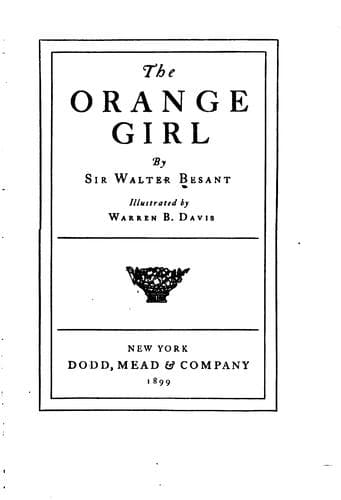
London (England) -- History -- 18th century -- Fiction
Among the collegians there was one who pleased me, though his raiment
was shabby to the last degree, by his manners, which were singularly
gentle; and his language, which was that of a scholar. He scorned the
vulgar idiom and turned with disgust from the universal verb (or
participle) with which annoyance or dislike or disappointment was
commonly expressed. And he spoke in measured terms as one who pronounces
a judgment. I heard afterward that he wrote critical papers on new books
in the _Gentlemen's Magazine_. But I never read new books unless they
are books of music. When he could afford to dine at the Ordinary, which
was about twice a week, he sat beside me and instructed me by his
discourse. He was a scholar of some college at Cambridge and a poet. I
sometimes think that it may be a loss to the world not to know its
poets. There are without doubt some who regard poetry as musicians
regard music. Now if the work of a Purcell or a Handel were to fall dead
and unnoticed it would be a most dreadful loss to music and a
discouragement for composers. So that there may be poets, of whom the
world hears nothing, whose verse is neglected and lost, though it might
be of great service to other poets or to mankind, if verse can in any
way help the world.
However, one day, when these two prisoners, the Captain and the Bishop,
had left the Ordinary and were brawling in the tavern hard by for a
bottle of Port, my friend the scholar turned to me.
'Sir,' he said, 'the Prison ought to be purged of such residents. They
should be sent to the Borough Compter or the Clink. Here we have
gentlemen: here we have tradesmen: here we have craftsmen: we are a
little World. Here are the temptations of the world': he looked across
the table where some of the ladies of the Prison were dining. 'The
tavern invites us: the gaming table offers us a seat: we have our
virtues and our vices. But we have not our crimes. And as a rule we
cannot boast among our company the presence of the Robber, the Forger,
or the Common Rogue. We have, in a word, no representative, as a rule of
the Gallows, the Pillory, the Stocks, the Cart-tail, and the Whipping
Post.'
I waited, for he did not like to be interrupted.
Public-domain text, read in full here on John Shaqi.
Reviews
Reviews
No reviews yet
Be the first to share your thoughts on this work.
Join the Discussion
Join the discussion
Sign in to leave a comment or review.
Sign InorCreate an account