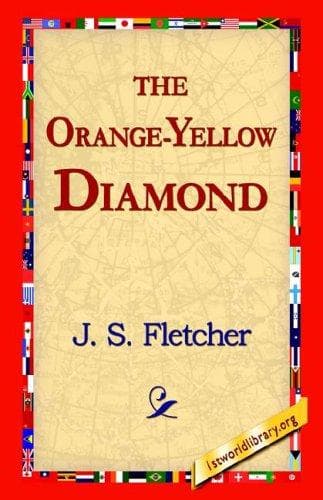
The Orange-Yellow DiamondFletcher, J. S. (Joseph Smith)
General
The Orange-Yellow Diamond
Fletcher, J. S. (Joseph Smith)
Detective and mystery stories; Diamonds -- Fiction; London (England) -- Fiction
"Nothing!" replied Lauriston. "It was all perfectly quiet."
"What had you gone there to do?"
"To borrow some money--on two rings."
"Your own property?"
"My own property!"
"Had you been there before, on any errand of that sort?"
"Only once."
"When was that?"
"Last week," answered Lauriston. "I pawned my watch there."
"You have, in fact, been short of money?"
"Yes. But only temporarily--I was expecting money."
"I hope it has since arrived," said the Coroner.
"Mr. Ayscough was with me when it did arrive," replied Lauriston,
glancing at the detective. "We found it--two letters--at my lodgings
when he walked round there with me after what I have just told you of."
"You had done your business on that previous occasion with the
grand-daughter?" asked the Coroner. "You had not seen the old man,
then?"
"I never to my knowledge saw Mr. Multenius till I found him lying dead
in his own parlour," answered Lauriston.
The Coroner turned from the witness, and glanced towards the table at
which Mr. Parminter and the police officials sat. And Mr. Parminter
slowly rose and looked at Lauriston, and put his first question--in a
quiet, almost suave voice, as if he and the witness were going to have
a pleasant and friendly little talk together.
"So your ambition is to be a writer of fiction?" he asked.
"I am a writer of fiction!" replied Lauriston.
Mr. Parminter pulled out a snuff-box and helped himself to a pinch.
"Have you published much?" he enquired, drily.
"Two or three stories--short stories."
"Did they bring in much money?"
"Five pounds each."
"Have you done anything else for a living but that since you came to
London two years ago?"
"No, I haven't!"
"How much have you earned by your pen since you came, now?"
"About thirty pounds."
"Thirty pounds in two years. What have you lived on, then?"
"I had money of my own," replied Lauriston. "I had two hundred pounds
when I left home."
"And that gave out--when?" demanded Mr. Parminter.
"Last week."
"And so--you took your watch to the pawnshop. And--yesterday--your
expected money not having arrived, you were obliged to visit the
pawnshop again? Taking with you, you said just now, two rings--your own
property. Am I correct?"
"Quite correct--two rings--my own property."
Mr. Parminter turned and spoke to a police official, who, lifting aside
a sheet of brown paper which lay before him, revealed the tray of rings
which Lauriston and Ayscough had found on the table in Multenius's
parlour. At the same time, Mr. Parminter, lifting his papers, revealed
Lauriston's rings. He picked them up, laid them on the palm of his
hand, and held them towards the witness.
"Are these the rings you took to the pawnshop?" he asked.
"Yes!" replied Lauriston. "They were my mother's."
Mr. Parminter indicated the tray.
"Did you see this tray lying in the parlour in which you found the dead
man?" he enquired.
"I did."
"Did it strike you that your own rings were remarkably like the rings
in this tray?"
Public-domain text, read in full here on John Shaqi.
Reviews
Reviews
No reviews yet
Be the first to share your thoughts on this work.
Join the Discussion
Join the discussion
Sign in to leave a comment or review.
Sign InorCreate an account