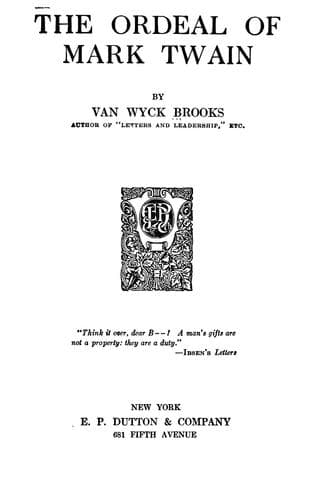
Authors, American -- 19th century -- Biography; Twain, Mark, 1835-1910
Mark Twain had accepted his father-in-law's challenge: he was not going
to fall behind the pace set by a coal-merchant whose household expenses
were $40,000 a year. No one ever delighted more than he now in living up
to those principles of "the conspicuous consumption of goods,"
"predatory emulation" and "the pecuniary canons of taste" which,
according to Mr. Veblen, actuate the propertied class. "A failure to
increase one's visible consumption when the means for an increase are at
hand is felt in popular apprehension," says Mr. Veblen, "to call for
explanation, and unworthy motives of miserliness are imputed to those
who fall short in this respect." Of course Mark Twain couldn't stand
that! As early as 1875 he writes to Mr. Howells: "You see I take a vile,
mercenary view of things--but then my household expenses are something
almost ghastly": he estimated that in the year 1881 he had spent
considerably more than $100,000. "It was with the increased scale of
living," says Mr. Paine, "that Clemens had become especially eager for
some source of commercial profit; something that would yield a return,
not in paltry thousands, but hundreds of thousands. Like Colonel
Sellers, he must have something with 'millions in it.'" This was the
visible sign that his mode of living had now become permanently
extravagant. In 1906, long after his wife had died and when he was
living much of the time virtually alone, his household expenses
amounted, according to Mr. Paine, "to more than fifty dollars a day. In
the matter of food, the choicest and most expensive the market could
furnish was always served in lavish abundance. He had the best and
highest-priced servants, ample as to number." Certainly his natural
taste, which was always, we are told, for a simple, inexpensive style,
would never have set that scale: it was a habit he had formed in those
early efforts to qualify as an admired citizen. And so was his
"disposition towards an expansive, all-round life," a disposition that
finally made all concentration impossible to him. "In his large
hospitality, and in a certain boyish love of grandeur," says Mr. Paine,
"he gloried in the splendor of his entertainment, the admiration and
delight of his guests. There were _always_ guests; they were coming and
going constantly. Clemens used to say that he proposed to establish a
'bus line between their house and the station for the accommodation of
his company.... For the better portion of the year he was willing to pay
the price of it, whether in money or in endurance"--after a while he
virtually gave up all thought of writing except during the summer
months: "I cannot write a book at home," he frankly told his
mother--"and Mrs. Clemens heroically did her part. She loved these
things also, in her own way. She took pride in them, and realized that
they were a part of his vast success. Yet in her heart she often longed
for the simpler life--above all, for the farm life at Elmira. Her spirit
Public-domain text, read in full here on John Shaqi.
Reviews
Reviews
No reviews yet
Be the first to share your thoughts on this work.
Elsewhere in the archive
Join the Discussion
Join the discussion
Sign in to leave a comment or review.
Sign InorCreate an account