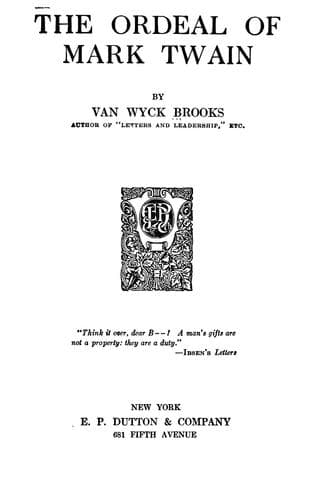
Authors, American -- 19th century -- Biography; Twain, Mark, 1835-1910
cried out for the rest and comfort there." Could anything be more
ironical? It was to satisfy her that he had repressed in himself the
child of light in order to become the child of this world, and now she
found herself actually drowning in the flood of that deflected energy!
To shine, meanwhile, to make money, to rival and outrival those whom the
public most admired had become Mark Twain's ruling passion. With the
beginning of his life in Buffalo he was already "a man of large
consequence and events," and I have suggested that in the process of
adapting himself all the latent instincts of his heritage had risen up
in him. Take, for instance, that mechanical ingenuity which is one of
the outstanding traits of the pioneer mind: it would certainly have
remained in abeyance if Mark Twain had followed his natural tendency and
become absorbed in literature. Now, however, with his ever-increasing
need of money, it came to the fore and was by way of turning him into a
professional inventor. At any rate, he invented, among other things, a
waistcoat enabling the wearer to dispense with suspenders, a shirt
requiring no studs, a perpetual calendar watch-charm, a method of
casting brass dies for stamping book-covers and wall-paper and a
postal-check to supplant the money-order in common use--not to mention
the "Mark Twain Scrap-Book" which he did not hesitate, so confused were
his artistic and his commercial motives, to promote under his own name.
He had, moreover, an unfailing interest in the mechanical devices of
other people. When he installed a telharmonium in his house at Redding
he made a little speech telling his friends that he had been the first
author in the world to use a type-writer for manuscript work--his
impression was that "Tom Sawyer" was the first book to be copied in
this way, but Mr. Paine thinks it was "Life on the Mississippi"--that he
had been one of the earliest users of the fountain-pen, and that his had
been the first telephone ever used in a private house. To this we can
add that he was one of the first to use the phonograph for dictation and
one of the first purchasers also of the high-wheeled bicycle. We can see
one reason for this eager interest in mechanical inventions in the fact
that out of it grew many of those adventures in financial speculation to
which also, in true pioneer fashion, Mark Twain was drawn like steel to
the magnet. He invested, and usually lost, large sums of money in the
following patents: a steam generator, a steam pulley, a new method of
marine telegraphy, a new engraving process, a new cash-register, a
spiral hatpin. His losses in almost every one of these enterprises
amounted to between twenty-five and thirty thousand dollars, and this is
not to mention the Paige Typesetting Machine, which cost him nearly two
hundred thousand dollars and whole years out of his life. He complained
of the anxiety these ventures caused him, of the frantic efforts he had
Public-domain text, read in full here on John Shaqi.
Reviews
Reviews
No reviews yet
Be the first to share your thoughts on this work.
Elsewhere in the archive
Join the Discussion
Join the discussion
Sign in to leave a comment or review.
Sign InorCreate an account