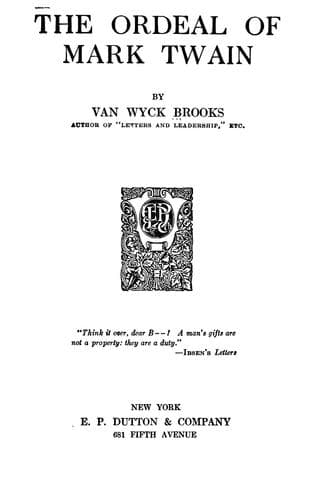
Authors, American -- 19th century -- Biography; Twain, Mark, 1835-1910
And how can we explain the fervor with which this comrade of
Presbyterian ministers and pillars of society, this husband of that
"heavenly whiteness," Mrs. Clemens, jots in his note-book observations
like the following: "We may not doubt that society in heaven consists
mainly of undesirable persons"? How can we explain that intemperate,
that vehement, that furious obsession of animosity against the novels of
Jane, Austen except as an indirect venting of his hatred of the primness
and priggishness of his own _entourage_? I should go even further, I
should be even more specific, than this. Mr. Howells had been Mark
Twain's literary mentor; Mr. Howells had "licked him into shape," had
regenerated him artistically as his wife had regenerated him socially;
Mr. Howells had set his pace for him, and Mark Twain, the candidate for
gentility, had been over-flowingly grateful. "Possibly," he had written
to this father confessor, "possibly you will not be a fully accepted
classic until you have been dead one hundred years--it is the fate of
the Shakespeares of all genuine professions--but then your books will be
as common as Bibles, I believe. In that day, I shall be in the
encyclopedias too, thus: 'Mark Twain, history and occupation unknown;
but he was personally acquainted with Howells.'" We know, as a matter of
fact, that he delighted in the delicacy of Howells's mind and language.
But this taste was wholly unrelated to anything else in Mark Twain's
literary horizon. We can say, with all the more certainty because he
"detested" novels in general, that if Howells's novels had been written
by any one else than his friend and his mentor he would have ignored
them as he ignored all other "artistic" writing, he would even have
despised them as he despised all insipid writing. In short, this taste
was a product of personal affection and gratitude; it was precisely on a
par with his attitude toward the provincial social daintinesses of his
wife. And in both cases, just in the measure that his conscious self had
accepted these alien standards that had been imposed upon him, his
unconscious self revolted against them. "I never saw a woman so hard to
please," he writes in 1875, "about things she doesn't know anything
about." Mr. Paine hastens to assure us that "the reference to his wife's
criticism in this is tenderly playful, as always." But what a multitude
of dark secrets that tender playfulness covers! Mark Twain's unconscious
self barely discloses its claws in phrases like that, enough to show how
strict was the censorship he had accepted. It cannot express itself
directly; consequently, like a child who, desiring to strike its
teacher, stamps upon the floor instead, it pours out its accumulated
bitterness obliquely. When Mark Twain utters such characteristic
aphorisms as "Heaven for climate, hell for society," we see the
repressed artist in him striking out at Mrs. Clemens and the Reverend
Public-domain text, read in full here on John Shaqi.
Reviews
Reviews
No reviews yet
Be the first to share your thoughts on this work.
Elsewhere in the archive
Join the Discussion
Join the discussion
Sign in to leave a comment or review.
Sign InorCreate an account