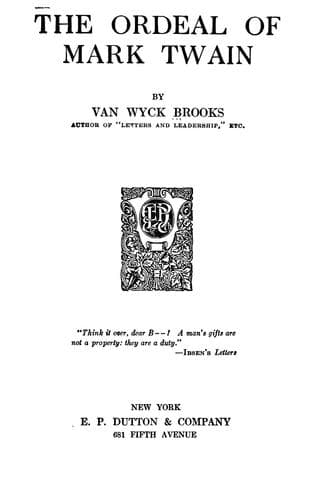
Authors, American -- 19th century -- Biography; Twain, Mark, 1835-1910
Do we not recall the early youth of that most unhumorous soul Henrik
Ibsen, who, as an apothecary's apprentice in a little provincial town,
found it impossible, as he wrote afterward, "to give expression to all
that fermented in me except by mad, riotous pranks, which brought down
upon me the ill-will of all the respectable citizens, who could not
enter into that world which I was wrestling with alone"? Any young man
with a highly developed individuality would have reacted in the same
way; Mark Twain had committed the same "mad, riotous pranks" in his own
childhood, and with the same effect upon the respectable citizens of
Hannibal: if he had been as conscious as Ibsen and had not been obliged
by that old pledge to his mother to make terms with his environment, his
antagonism would have ultimately taken the form, not of humor, but of
satire also. For it began as satire. He had the courage of the kindest
of hearts, the humanest of souls: to that extent the poet was awake in
him. His attacks on corrupt officials were no more vehement than his
pleas on behalf of the despised Chinese, who were cuffed and maltreated
and swindled by the Californians. In these attacks and these pleas alike
he was venting the humane desires of the pioneers themselves: that is
the secret of his "daily philippics." San Francisco was "weltering in
corruption" and the settlers instinctively loathed this condition of
things almost as much as did Mark Twain himself. They could not
seriously undertake to reform it, however, because this corruption was
an inevitable part of a social situation that made their own adventure,
their own success as gambling miners, possible. The desire to change
things, to reform things was checked in the individual by a
counter-desire for unlimited material success that throve on the very
moral and political disorder against which all but his acquisitive
instincts rebelled. In short, had Mark Twain been permitted too long to
express his indignation directly in the form of satire, it would have
led sooner or later to a reorientation of society that would have put an
end to the conditions under which the miners flourished, not indeed as
human beings, but as seekers of wealth. Consequently, while they admired
Mark Twain's vehemence and felt themselves relieved through it--a relief
they expressed in their "storms of laughter and applause," they could
not, beyond a certain point, permit it. Mark Twain, as we know, had been
compelled to leave Nevada to escape the legal consequences of a duel. He
had gone to San Francisco, where he had immediately engaged in such a
campaign of "muck-raking" that the officials "found means," as Mr. Paine
says, "of making the writer's life there difficult and comfortless." As
a matter of fact, "only one of the several severe articles he wrote
criticising officials and institutions seems to have appeared," the
result being that he lost all interest in his work on the San Francisco
papers.
Public-domain text, read in full here on John Shaqi.
Reviews
Reviews
No reviews yet
Be the first to share your thoughts on this work.
Elsewhere in the archive
Join the Discussion
Join the discussion
Sign in to leave a comment or review.
Sign InorCreate an account