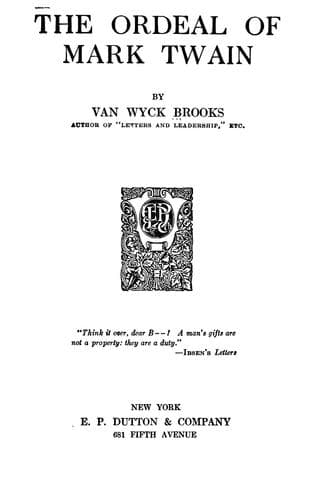
Authors, American -- 19th century -- Biography; Twain, Mark, 1835-1910
When, on the other hand, he wrote about San Francisco as a
correspondent for his paper in the rival community in Nevada, it was, we
are told, "with all the fierceness of a flaming indignation long
restrained." His impulse, his desire, we see, was not that of the
"humorist"; it was that of the satirist; but whether in Nevada or in
California he was prohibited, on pain of social extinction, from
expressing himself directly regarding the life about him. Satire, in
short, had become for him as impossible as murder: he was obliged to
remain a humorist.
In an old pamphlet about Mark Twain published in the eighties I discover
the report of a phrenologist, one "Professor Beall" of Cincinnati, who
found the trait of secretiveness very strongly indicated in the diameter
of his head just above the ears. Such testimony, I suppose, has no
value; but it is surely significant that this gentleman found the same
trait exhibited in Mark Twain's "slow, guarded manner of speech."
Perhaps we can understand now the famous Mark Twain "drawl," which he
had inherited indeed, but which people say he also cultivated. Perhaps
we can understand also why it is that half the art of American humor
consists in "keeping one's face straight." These humorists! They don't
know themselves how much they are concealing; and they would be as
surprised as anybody to learn that they are really social revolutionists
of a sort who lack the courage to admit it.
Mark Twain, once committed to the pursuit of success, was obliged, as I
say, to remain a humorist whether he would or no. When he went East to
carry on his journalistic career, the publishers of _The Galaxy,_ to
which he became a regular contributor, specifically asked him to conduct
a "humorous department"; and after the success of "The Innocents Abroad"
his publisher Bliss, we find, "especially suggested and emphasized a
humorous work--that is to say, a work humorously inclined." We have
already seen, in a previous chapter, that whatever was true of the
pioneer society on the Pacific Slope was essentially true also of the
rest of the American population during the Gilded Age, that the business
men of the East were in much the same case as the pioneers of the West.
The whole country, as we know, was as thirsty for humor as it was for
ice water: Mark Twain's humor fulfilled during its generation a national
demand as universal in America as the demand fulfilled in Russia by
Dostoievsky in France by Victor Hugo, in England by Dickens. We have at
last begun to approach the secret of this interesting fact.
Public-domain text, read in full here on John Shaqi.
Reviews
Reviews
No reviews yet
Be the first to share your thoughts on this work.
Elsewhere in the archive
Join the Discussion
Join the discussion
Sign in to leave a comment or review.
Sign InorCreate an account