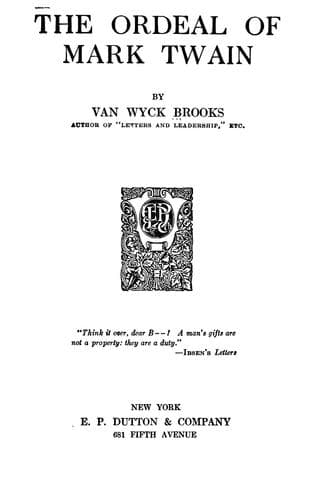
Authors, American -- 19th century -- Biography; Twain, Mark, 1835-1910
It is probable that by 1975 those memoirs will seem to the
publishing world a very doubtful commercial risk.
Mark Twain's view of man, in short, was quite rudimentary. He considered
life a mistake and the human animal the contemptible machine he had
found him: that argues the profundity of his own temperament, the depth
and magnitude of his own tragedy, but it argues little else. The
absurdity of man consisted, in Mark Twain's eyes, in his ridiculous
conception of heaven and his conceit in believing himself the Creator's
pet. But surely those are not the significant absurdities. "His heaven
is like himself: strange, interesting, astonishing, grotesque," he wrote
in one of those pseudo-Swiftian "Letters from the Earth," which he
dictated with such fervor to Mr. Paine. "I give you my word it has not a
single feature in it that he _actually values_. It consists--utterly
and entirely--of diversions which he cares next to nothing about here on
the earth, yet he is quite sure he will like in heaven.... Most men do
not sing, most men cannot sing, most men will not stay where others are
singing if it be continued more than two hours. Note that. Only about
two men in a hundred can play upon a musical instrument, and not four in
a hundred have any wish to learn how. Set that down. Many men pray, not
many of them like to do it.... All people, sane or insane, like to have
variety in their lives. Monotony quickly wearies them. Now, then, you
have the facts. You know what men don't enjoy. Well, they have invented
a heaven, out of their own heads, all by themselves; guess what it is
like?" How far does that satirical gesture carry us? It is too
rustically simple in its animus, and its presuppositions about the
tastes of humanity are quite erroneous: to sing, to play and to pray,
in some fashion or other, are universal, admirable and permanent
impulses in man. What is the moral even of that marvelous Odyssey of
"Huckleberry Finn"? That all civilization is inevitably a hateful error,
something that stands in the way of life and thwarts it as the
civilization of the Gilded Age had thwarted Mark Twain. But that is the
illusion, or the disillusion, of a man who has never really known what
civilization is, who, in "The Stolen White Elephant," like H.G. Wells in
his early tales, delights in the spectacle of a general smash-up of a
world which he cannot imagine as worth saving because he has only seen
it as a fool's paradise. What is the philosophy of "The Man That
Corrupted Hadleyburg"? "That every man is strong," as Mr. Paine says,
"until his price is named." But that is not true, to the discriminating
sense, at all. It is an army of fifty-two boys that the Connecticut
Yankee collects in order to start the English republic: in childhood,
and childhood alone, in short, had Mark Twain ever perceived the vaunted
nobility of the race. The victim of an arrested development, the victim
of a social order which had given him no general sense of the facts of
Public-domain text, read in full here on John Shaqi.
Reviews
Reviews
No reviews yet
Be the first to share your thoughts on this work.
Elsewhere in the archive
Join the Discussion
Join the discussion
Sign in to leave a comment or review.
Sign InorCreate an account