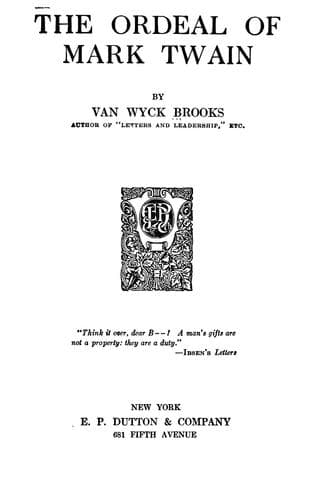
Authors, American -- 19th century -- Biography; Twain, Mark, 1835-1910
life and no sense whatever of its possibilities, he poured vitriol
promiscuously over the whole human scene. But that is not satire: that
is pathology.
Mark Twain's imagination was gigantesque: his eye, in later life, was
always looking through the small end or the large end of a telescope; he
oscillated between the posture of Gulliver in Lilliput and the posture
of Gulliver in Brobdingnag. That natural tendency toward a magnification
or a minification of things human is one of the ear-marks of the
satirist. In order to be effectual, however, it requires a measure, an
ideal norm, which Mark Twain, with his rudimentary sense of proportion,
never attained. It was not fear alone then, but an artistic sense also
that led him to suppress, and indeed to leave incomplete, most of the
works in which this tendency manifested itself. One recalls his "3000
Years Among the Microbes," passages of which have been published by Mr.
Paine. Glance at another example. "I have imagined," he said once, "a
man three thousand miles high picking up a ball like the earth and
looking at it and holding it in his hand. It would be about like a
billiard-ball to him, and he would turn it over in his hand and rub it
with his thumb, and where he rubbed over the mountain ranges he might
say, 'There seems to be some slight roughness here, but I can't detect
it with my eye; it seems perfectly smooth to look at.'" There we have
the Swiftian, the Rabelaisian note, the Rabelaisian frame for the
picture that fails to emerge. The fancy exists in his mind, but he is
able to do nothing with it: all he can do is to express a simple
contempt, to rule human life as it were out of court. Mark Twain never
completed these fancies precisely, one can only suppose, because they
invariably led into this _cul-de-sac_. If life is really futile, then
writing is futile also. The true satirist, however futile he may make
life seem, never really believes it futile: his interest in its futility
is itself a desperate registration of some instinctive belief that it
might be, that it could be, full of significance, that, in fact, it _is_
full of significance: to him what makes things petty is an ever-present
sense of their latent grandeur. That sense Mark Twain had never
attained: in consequence, his satirical gestures remained mere passes in
the air.
CHAPTER XI
MUSTERED OUT
"... a man who awoke too early in the darkness, while the
others were all still asleep." DMITRI MEREJKOWSKI.
And so we come to Mark Twain's last phase, to that hour when, outwardly
liberated at last from the bonds and the taboos that have thwarted him
and distorted him, he turns and rends the world in the bitterness of his
defeat.
Public-domain text, read in full here on John Shaqi.
Reviews
Reviews
No reviews yet
Be the first to share your thoughts on this work.
Elsewhere in the archive
Join the Discussion
Join the discussion
Sign in to leave a comment or review.
Sign InorCreate an account