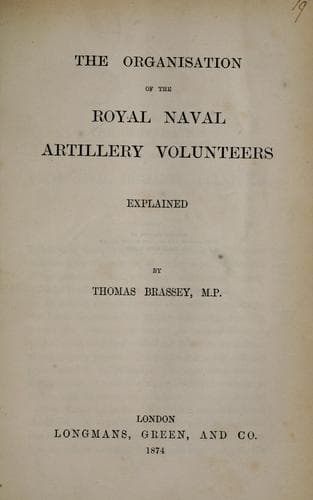
The Organisation of the Royal Naval Artillery Volunteers ExplainedBrassey, Thomas Brassey, Earl
History
The Organisation of the Royal Naval Artillery Volunteers Explained
Brassey, Thomas Brassey, Earl
Great Britain. Royal Naval Artillery Volunteers
The railway and the telegraph afford the means of concentrating large
bodies of men in a few hours at any port on the shores of the United
Kingdom. Wherever the coast-guard are stationed, the means exist of
giving instruction to the Naval Volunteers. All the out-ports, at which
men have been enrolled, can be visited by a gunboat at frequent
intervals, to embark the Volunteers for target practice afloat; while
those who wish to go to sea for an eight days' cruise, will have, every
year, the opportunity of doing so.
[Sidenote: The Volunteer movement.]
In conclusion, it may not be superfluous to offer a few observations on
the Volunteer movement generally. The most cogent inducements to
Volunteer activity may appear to be wanting at the present time. Our
country is happily not threatened with the danger of foreign invasion. A
becoming modesty will deter any individual connected with the Volunteer
service from arrogating to himself any share in the prestige and
distinction, which are the special privilege of the regular services. It
is an essential feature of the present movement that there shall be no
contribution from the state in the form of pecuniary reward for services
rendered; and that every effort shall be made by the Volunteers to
impose as small a burden as possible on the Exchequer. The sterner sense
of duty, which is now encouraged among the Volunteers for land service,
is opposed to all attempts to gain popularity for the auxiliary forces
by festivals, holidays, and entertainments.
While, however, all these inducements and attractions are withheld, a
higher standard of efficiency in the officers and the men is properly
insisted on. In presence of the difficulties which arise from the
altered conditions of the service, some earnest friends of the Volunteer
movement have been oppressed with doubts, as to the possibility of
stimulating the patriotism of the country to such a pitch, that
Volunteers shall still be forthcoming in a time of profound peace. I do
not conceal my individual opinion that compulsory service may fairly be
required, from every individual of military age, when the country is in
danger. Unfortunately, so strong a measure would probably meet with an
amount of resistance, which could not be overcome in this free country,
where nothing affecting the social habits and prejudices of the people
can be proposed, which is not universally popular. But I venture to hope
that we may rely, in the absence of direct legal compulsion, on motives
even more powerful than the strong arm of the law. If every man who is
capable of co-operating in the defence of his country should feel
himself compelled, by his sense of duty and patriotism, to enter his
name in the roll of her defenders, the liability to service, thus
imposed by the free will of the Volunteer upon himself, will be a far
more effectual safeguard than legal compulsion, for the security and the
honour of England.
Public-domain text, read in full here on John Shaqi.
Reviews
Reviews
No reviews yet
Be the first to share your thoughts on this work.
Join the Discussion
Join the discussion
Sign in to leave a comment or review.
Sign InorCreate an account