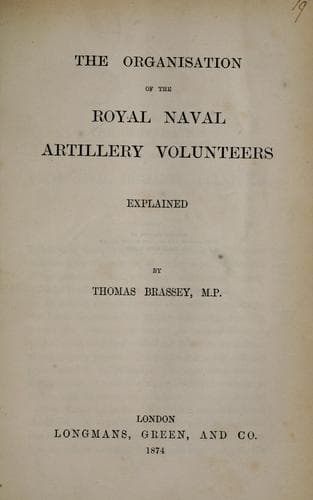
The Organisation of the Royal Naval Artillery Volunteers ExplainedBrassey, Thomas Brassey, Earl
History
The Organisation of the Royal Naval Artillery Volunteers Explained
Brassey, Thomas Brassey, Earl
Great Britain. Royal Naval Artillery Volunteers
[Sidenote: New Corps not to be formed under certain circumstances.]
10. The formation of a new Corps will not be sanctioned, unless a
sufficient number of persons to form a Battery are prepared to enrol
themselves, and whilst any Battery already existing in the locality is
below its establishment.
[Sidenote: Information to be given on application.]
11. In offering the services of a new Corps for acceptance, it should be
stated:--
(_a_) The place proposed for its head-quarters.
(_b_) The number of persons who are prepared to enrol themselves.
(_c_) The name and address of some person with whom communications
on the subject may be made.
(_d_) The Brigade of which it will form a part.
(_e_) That a proper place will be secured for the safe custody of
any Government arms and ammunition which may be issued.
(Form in Appendix A.)
[Sidenote: Single Brigade.]
12. Whenever it is practicable, a Brigade will be formed at each of the
large ports in the Kingdom, and the batteries composing the Brigade will
be raised in the immediate neighbourhood of the port.
[Sidenote: District Brigade.]
When the Volunteers are not of sufficient strength at any port to form a
Brigade, the batteries enrolled on a part of the coast formed into a
district, will be formed into a Brigade, and will be called a District
Brigade.
The object of this organization is to unite separate batteries under one
head, to secure uniformity among them, and to afford them the advantage
of an Officer Instructor.
PRECEDENCE AND COMMAND.
[Sidenote: Rank of the Force.]
13. The "Royal Naval Artillery Volunteer Force" takes precedence
immediately after the "Royal Naval Volunteers" established by the Act of
1859.
[Sidenote: Precedence of Brigades.]
14. The relative precedence of the Brigades forming the Force is
determined by the date on which they were first severally established.
[Sidenote: Precedence of Corps.]
15. The relative precedence of Corps is determined by the date on which
the Secretary of the Admiralty has first received a letter offering the
services of the Corps.
[Sidenote: Precedence of Officers with others.]
16. Officers of the Royal Naval Artillery Volunteers rank with, but
after, Officers of the Royal Navy and Royal Naval Reserve of their
respective ranks.
[Sidenote: Precedence of Officers with each other.]
17. The relative precedence of Officers of the whole Force is determined
solely by the rank and date of their commissions in the Force.
[Sidenote: Precedence of Officers of same date.]
18. The relative precedence of Officers bearing commissions of the same
date is determined by the order in which their names appear in the Navy
List.
Nothing in these Regulations is to give a claim to any Officer of the
Royal Naval Artillery Volunteers to assume command of any of Her
Majesty's Land Forces on shore, nor to any Officer of Her Majesty's Land
Forces to assume command of any of Her Majesty's Naval Forces.
Public-domain text, read in full here on John Shaqi.
Reviews
Reviews
No reviews yet
Be the first to share your thoughts on this work.
Join the Discussion
Join the discussion
Sign in to leave a comment or review.
Sign InorCreate an account