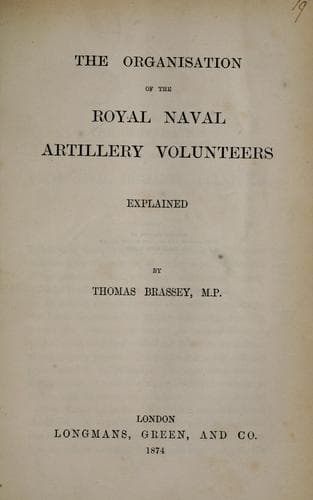
The Organisation of the Royal Naval Artillery Volunteers ExplainedBrassey, Thomas Brassey, Earl
History
The Organisation of the Royal Naval Artillery Volunteers Explained
Brassey, Thomas Brassey, Earl
Great Britain. Royal Naval Artillery Volunteers
37. Men belonging to any other force liable to be called out for service
in case of war are not to be enrolled.
Apprentices are not to be enrolled without the consent of their masters.
Persons dismissed from any other Service or Corps for misconduct are not
to be enrolled without the special sanction of the Admiralty.
[Sidenote: Certificate of Discharge.]
38. The Commanding Officer of a Corps is to give to any Volunteer, on
his quitting the Corps, a Certificate of Discharge, in Form B of the
Appendix, when requested to do so by such Volunteer.
[Sidenote: Classification.]
39. Enrolled Members are classed as Efficients and non-Efficients.
[Sidenote: Efficients.]
40. An Efficient Member must have fulfilled the conditions prescribed by
the Admiralty from time to time.
[Sidenote: Non-Efficients.]
41. All Enrolled Members who do not fulfil the conditions above referred
to are reckoned as non-Efficients.
HONORARY MEMBERS.
[Sidenote: Number and position.]
42. The number of Honorary Members attached to any Corps is not
regulated by the Admiralty, and such Members are not included in the
muster-roll of the Corps to which they are attached.
They are not subject to discipline nor allowed to interfere with the
duties of the Corps, but they are permitted to wear its uniform, unless
a special provision to the contrary is contained in the authorised Rules
of the Corps.
RULES.
[Sidenote: Must be approved.]
43. In order to give legal force to the Rules of a Corps for the
management of its affairs, they must be submitted to the Admiralty for
approval.
[Sidenote: To be transmitted in duplicate.]
44. All Rules which are to be forwarded for approval must be transmitted
in duplicate, one copy to be retained at the Admiralty, the other to be
returned to the Corps, with any alterations that may be required.
COURTS OF INQUIRY.
[Sidenote: Nature of.]
45. A Court of Inquiry is not a judicial body; it has no power to
administer an oath.
It is to be considered as a Board of which the Admiralty or an Officer
in command of a Brigade or Corps may make use, to assist him in arriving
at a correct judgment on any subject upon which it may be expedient to
institute an inquiry.
[Sidenote: Duties of.]
46. The duties of a Court of Inquiry depend on the instructions which
the convening authority may think proper to give.
It may be either employed merely in collecting and arranging evidence,
or it may, in addition, be directed to give an opinion as to the facts
established by that evidence; but it has no power to pronounce any
judgment as to the course to be taken by the convening authority in
dealing with those facts.
Public-domain text, read in full here on John Shaqi.
Reviews
Reviews
No reviews yet
Be the first to share your thoughts on this work.
Join the Discussion
Join the discussion
Sign in to leave a comment or review.
Sign InorCreate an account