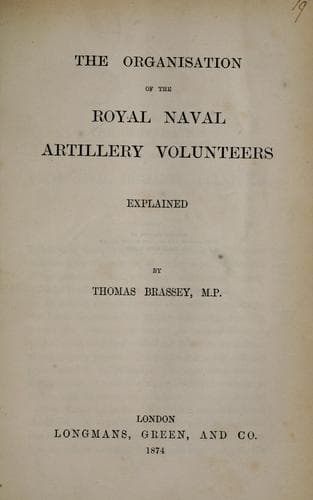
The Organisation of the Royal Naval Artillery Volunteers ExplainedBrassey, Thomas Brassey, Earl
History
The Organisation of the Royal Naval Artillery Volunteers Explained
Brassey, Thomas Brassey, Earl
Great Britain. Royal Naval Artillery Volunteers
It has already been explained that these qualifications may easily be
acquired in a fortnight of continuous attendance at drill, by the
application of a very ordinary amount of intelligence and attention. The
regulations expressly avoid the imposition of any compulsory service
afloat in time of peace. Target practice afloat is obviously essential
to the efficiency of a naval gunner; and it is therefore desirable that
every volunteer should have a fair number of opportunities of taking
part in this useful exercise. In a long summer's day, the members of the
London Brigade may embark in a gunboat at Erith or Gravesend, proceed to
the Maplin Sands, off Shoeburyness--which is the most convenient place
for firing practice over a sea range--and return to London by a
convenient hour in the afternoon or evening. It will doubtless be the
desire of every naval volunteer to avail himself of a sufficient number
of opportunities for target practice, to secure his own efficiency. But,
as there are many who will be anxious to have a greater amount of
exercise afloat, every volunteer, who wishes it, may embark once a year,
and remain for a period of eight days in a gunboat, manned by a crew to
be furnished from the battery to which he himself belongs. It should,
however, be observed that, when called out for actual service, the
volunteers will not be liable to embark in sea-going vessels. Whenever
so assembled, they will serve on board any of H.M, ships employed in the
defence of the coasts of the United Kingdom; unless, indeed, they
volunteer for, and are found capable of doing duty in, sea-going
cruisers. They will not be required to go aloft, or to attend to the
fires in the stoke-hole. They will, however, have to accommodate
themselves to the berthing and messing arrangements usual for the seamen
of the Royal Navy.
[Sidenote: Regulations issued by the Admiralty.]
The regulations recently issued contain ample information as to the
organisation of the Royal Naval Artillery Volunteers; and their
practical effect will be summarised in the following extracts from the
code of rules.
The Volunteers are raised under the Act passed in 1873. They will be
called out by Royal proclamation, and will be liable to serve in any
vessels employed for coast defence. They will be liable to perform all
the ordinary duties of the vessels in which they may be embarked, in the
same manner as those duties are performed by the regular crews of Her
Majesty's ships, except those duties that can only be performed by
practical seamen.
The Royal Naval Artillery Volunteer force, for administrative purposes,
will be formed into brigades, and each brigade will consist of four or
more batteries of from 60 to 80 men. Each brigade will be designated by
a local name.
The following table contains the authorised establishment for brigades
and the batteries composing them:--
Public-domain text, read in full here on John Shaqi.
Reviews
Reviews
No reviews yet
Be the first to share your thoughts on this work.
Join the Discussion
Join the discussion
Sign in to leave a comment or review.
Sign InorCreate an account