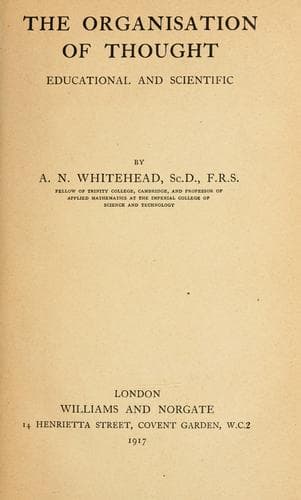
The organisation of thought, educational and scientificWhitehead, Alfred North
Philosophy
The organisation of thought, educational and scientific
Whitehead, Alfred North
Education
Analogously, there are certain relations between events which we
express by saying that they are relations between the temporal
durations of these events, that is, between the temporal extensions of
the events. [The durations of two events A and B may one precede the
other, or may partially overlap, or may one contain the other, giving
in all six possibilities.] The properties of the extension of an event
in time are largely analogous to the extension of an object in space.
Spatial extensions are expressed by relations between objects, temporal
extensions by relations between events.
The point in time is a set of relations between temporal extensions.
It needs very little reflection to convince us that a point in time
is no direct deliverance of experience. We live in durations, and not
in points. But what community, beyond the mere name, is there between
extension in time and extension in space? In view of the intimate
connection between time and space revealed by the modern theory of
relativity, this question has taken on a new importance.
I have not thought out an answer to this question. I suggest, however,
that time and space embody those relations between objects on which
depends our judgment of their externality to ourselves. Namely,
location in space and location in time both embody and perhaps
necessitate a judgment of externality. This suggestion is very vague,
and I must leave it in this crude form.
_Diverse Euclidean Measure Systems_
Turning now to the mathematical investigations on the axioms of
geometry, the outcome, which is most important for us to remember,
is the great separation which it discloses between non-metrical
projective geometry, and metrical geometry. Non-metrical projective
geometry is by far the more fundamental. Starting with the concepts
of points, straight lines, and planes (of which not all three need
be taken as indefinable), and with certain very simple non-metrical
properties of these entities--such as, for instance, that two points
uniquely determine a straight line--nearly the whole of geometry can
be constructed. Even quantitative coordinates can be introduced, to
facilitate the reasoning. But no mention of distance, area, or volume,
need have been introduced. Points will have an order on the line, but
order does not imply any settled distance.
Public-domain text, read in full here on John Shaqi.
Reviews
Reviews
No reviews yet
Be the first to share your thoughts on this work.
Elsewhere in the archive
Join the Discussion
Join the discussion
Sign in to leave a comment or review.
Sign InorCreate an account