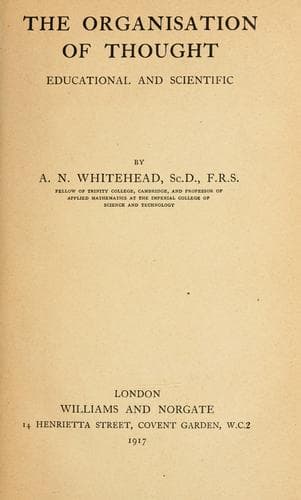
The organisation of thought, educational and scientificWhitehead, Alfred North
Philosophy
The organisation of thought, educational and scientific
Whitehead, Alfred North
Education
We may conceive of the points of space as self-subsistent entities
which have the indefinable relation of being occupied by the ultimate
stuff (matter, I will call it) which is there. Thus, to say that the
sun is _there_ (wherever it is) is to affirm the relation of
occupation between the set of positive and negative electrons which
we call the sun and a certain set of points, the points having an
existence essentially independent of the sun. This is the absolute
theory of space. The absolute theory is not popular just now, but it
has very respectable authority on its side--Newton, for one--so treat
it tenderly.
The other theory is associated with Leibniz. Our space concepts are
concepts of relations between things in space. Thus there is no such
entity as a self-subsistent point. A point is merely the name for some
peculiarity of the relations between the matter which is, in common
language, said to be in space.
It follows from the relative theory that a point should be definable in
terms of the relations between material things. So far as I am aware,
this outcome of the theory has escaped the notice of mathematicians,
who have invariably assumed the point as the ultimate starting ground
of their reasoning. Many years ago I explained some types of ways in
which we might achieve such a definition, and more recently have added
some others. Similar explanations apply to time. Before the theories
of space and time have been carried to a satisfactory conclusion on
the relational basis, a long and careful scrutiny of the definitions
of points of space and instants of time will have to be undertaken,
and many ways of effecting these definitions will have to be tried and
compared. This is an unwritten chapter of mathematics, in much the same
state as was the theory of parallels in the eighteenth century.
In this connection I should like to draw attention to the analogy
between time and space. In analysing our experience we distinguish
events, and we also distinguish things whose changing relations form
the events. If I had time it would be interesting to consider more
closely these concepts of events and of things. It must suffice now to
point out that things have certain relations to each other which we
consider as relations between the space extensions of the things; for
example, one space can contain the other, or exclude it, or overlap
it. A point in space is nothing else than a certain set of relations
between spatial extensions.
Public-domain text, read in full here on John Shaqi.
Reviews
Reviews
No reviews yet
Be the first to share your thoughts on this work.
Elsewhere in the archive
Join the Discussion
Join the discussion
Sign in to leave a comment or review.
Sign InorCreate an account