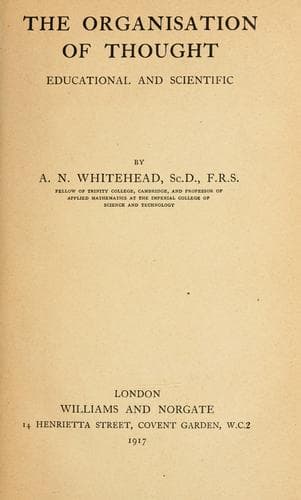
The organisation of thought, educational and scientificWhitehead, Alfred North
Philosophy
The organisation of thought, educational and scientific
Whitehead, Alfred North
Education
Now, suppose there are two observers, A and B. They agree in their
non-metrical projective geometry, _e.g._, what A calls a straight
line so does B. They also both apply a Euclidean metrical system of
measurement to this space. Their two metrical systems also agree in
having the same plane at infinity, that is, lines which are parallel
for A are also parallel for B. Furthermore, they have both successfully
applied Newton's laws to the movement of matter, and agree in having
the same sets of dynamical axes. But the framework (among these sets)
which A chooses to regard as at rest is different from the frame (among
the same sets) which B so regards.
Without alteration of their respective judgment of rest, they choose
their co-ordinate axes so that the origins (O for A, and O′ for B) are
in relative motion along OO′, which is the axis of _x_ for both.
Further, since OO′ is the line of symmetry of their diverse Euclidean
systems, we assume that the two measure-systems agree for planes
perpendicular to OO′, _i.e._, we assume a symmetry round OO′.
Then if, for A at O, the distance OO′ be ξ, the relations at any
instant between A's coordinates (_x_, _y_, _z_) and B's
coordinates (_x′_, _y′_, _z′_) for the same point P are
given by
_x′_ = β(_x_ - ξ), _y′_ = _y_, _z′_ = _z_.
Also, according to A's clock, O′ is moving forward with a uniform
velocity _v_, and we measure A's time from the instant of the
coincidence of O and O′.
Thus
ξ = _vt_,
and
_x′_ = β(_x_ - _vt_), _y′_ = _y_, _z′_ = _z_.
We now consider B's clock, and ask for the most general supposition
which is consistent with the fact that their judgments as to the fact
of uniform motion are in agreement.
We do not assume that events in various parts of space which A
considers to be simultaneous are so considered by B. But we assume that
at any point P, with coordinates (_x_, _y_, _z_) for A, there is a
determinate relation between B's time T and _x_, _y_, _z_, _t_.
Put
T = ƒ(_x_, _y_, _z_, _t_).
Write
P = δT/δ_x_, Q = δT/δ_y_, R = δT/δ_z_, S = δT/δ_t_.
Now suppose that the point P is moving, and that (_u_{1},
_u_{2}, _u_{3}) is its set of component velocities along
the axes according to A's "space and clock" system, and (U_{1}, U_{2},
U_{3}) is its set of component velocities according to B's "space and
clock" system. Then by mere differentiation it follows after a short
mathematical deduction that
U_{1} = {(_d_β/_dt_)(_x_ - _vt_) + β(_u_{1} - _v_)}/{P_u_{1} + Q_u_{2} + R_u_{3} + S},
U_{2} = _u_{2}/{P_u_{1} + Q_u_{2} + R_u_{3} + S},
U_{3} = _u_{3}/{P_u_{1} + Q_u_{2} + R_u_{3} + S}.
But we have assumed that, whatever the direction of the resultant
velocity (_u_{1}, _u_{2}, _u_{3}), the velocities (U_{1}, U_{2}, U_{3})
and (_u_{1}, _u_{2}, _u_{3}) are both uniform when either is uniform.
Hence it is easily proved that β, P, Q, R, S are independent of the
coordinates (_x_, _y_, _z_) and of the time _t_. In other words, they
are constant.
Hence we obtain
Public-domain text, read in full here on John Shaqi.
Reviews
Reviews
No reviews yet
Be the first to share your thoughts on this work.
Elsewhere in the archive
Join the Discussion
Join the discussion
Sign in to leave a comment or review.
Sign InorCreate an account