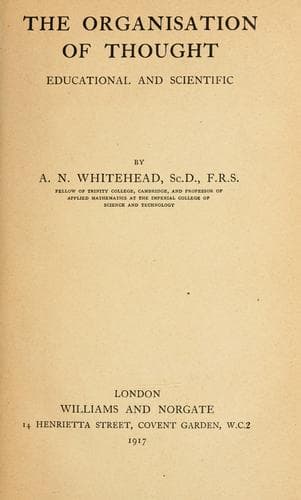
The organisation of thought, educational and scientificWhitehead, Alfred North
Philosophy
The organisation of thought, educational and scientific
Whitehead, Alfred North
Education
U_{1} = β(_u_{1} - _v_)/{P_u_{1} + Q_u_{2} + R_u_{3} + S},
and
T = P_x_ + Q_y_ + R_z_ + S_t_.
But we assumed that OO′, _i.e._, O_x_, is an axis of
symmetry. It follows from this assumption that
Q = R = 0.
We thus obtain the simplified results
T = P_x_ + S_t_, }
U_{1} = β(_u_{1} - _v_)/(P_u_{1} + S), } (I)
U_{2} = _u_{2}/(P_u_{1} + S), }
U_{3} = _u_{3}/(P_u_{1} + S). }
Here we remember that (_u_{1}, _u_{2}, _u_{3}) are
the velocities of any particle according to A's "space and clock"
system, and that (U_{1}, U_{2}, U_{3}) are the velocities of the same
point according to B's "space and clock" system. We have obtained the
most general relations consistent with the facts that (1) they both
employ Euclidean systems, related as described above, and (2) they
agree in their judgments on the uniformity of velocity.
We now compare their judgments on the magnitudes of velocities.
Let the magnitude of the velocity of P be V according to A's judgment,
and V′ according to B's’ judgment.
Then
V^2 = _u_{1}^2 + _u_{2}^2 + _u_{3}^2,
V′^2 = U_{1}^2 + U_{2}^2 + U_{3}^2.
Also we can put
_u_{1} = _l_V, _u_{2} = _m_V, _u_{3} = _n_V,
where (_l_, _m_, _n_) have nothing to do with the magnitude V, but
simply depend on the direction of motion. In fact (_l_, _m_, _n_) are
the "direction cosines" of the velocity according to A's judgment. By
substituting in the above equation for V^2 we see that
_l_^2 + _m_^2 + _n_^2 = 1.
Now, substituting for (_u_{1}, _u_{2}, _u_{3}) in
the equations (I) above, and squaring and adding, and eliminating
_m_^2 + _n_^2 by the relation just found, we at once find
V′^2 = ((β^2 - 1)V^2_l_^2 - 2β^2V_vl_ + β^2_v_^2 + V^2)/(PV_l_ + S)^2.
It is thus seen that in general the relation of V′ to V depends on the
direction cosine _l_. Now _l_ is the cosine of the angle
which the direction of the velocity V makes with O_x_, according
to A's judgment.
The meaning of this relation is, that if A discharges, from guns at
the point P, shells with a given muzzle velocity V according to his
judgment, B will consider that their muzzle velocities are different
from each other, except in the case of pairs of guns equally inclined
to the axis OO′. Instances of this type of diversity of judgment can
be noted any day by any one who looks out of the window of a railway
carriage, and forgets that he is travelling.
Now, suppose the velocity V′ bears a relation to the velocity V, which
is independent of _l_. Then _l_ must disappear from the above
formula. There are two conditions to be satisfied
One condition is
V^2 = β^2_v_^2/(β^2 - 1),
or in a more convenient form
β^2 = 1/(1 - _v_^2/V^2).
The meaning of this condition is, that there is one, and only one,
muzzle velocity V (according to A's judgment), namely, the muzzle
velocity given by the above formula, which can have the property that
B will judge that all the guns are firing in their diverse directions
with one common muzzle velocity.
Public-domain text, read in full here on John Shaqi.
Reviews
Reviews
No reviews yet
Be the first to share your thoughts on this work.
Elsewhere in the archive
Join the Discussion
Join the discussion
Sign in to leave a comment or review.
Sign InorCreate an account