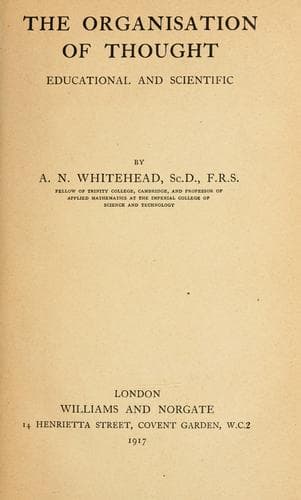
The organisation of thought, educational and scientificWhitehead, Alfred North
Philosophy
The organisation of thought, educational and scientific
Whitehead, Alfred North
Education
There are roughly two rival explanations. One is to assert the world
as a postulate. The other way is to obtain it as a deduction, not a
deduction through a chain of reasoning, but a deduction through a chain
of definitions which, in fact, lifts thought on to a more abstract
level in which the logical ideas are more complex, and their relations
are more universal. In this way the broken limited experiences sustain
that connected infinite world in which in our thoughts we live. There
are three more remarks while on this point I wish to make--
(i) The fact that immediate experience is capable of this deductive
superstructive must mean that it itself has a certain uniformity of
texture. So this great fact still remains.
(ii) I do not wish to deny the world as a postulate. Speaking without
prejudice, I do not see how in our present elementary state of
philosophical advance we can get on without middle axioms, which, in
fact, we habitually assume.
My position is, that by careful scrutiny we should extrude such
postulates from every part of our organised knowledge in which it is
possible to do without them.
Now, physical science organises our knowledge of the relations between
the deliverances of our various senses. I hold that in this department
of knowledge such postulates, though not entirely to be extruded, can
be reduced to a minimum in the way which I have described.
I have not the slightest knowledge of theories respecting our emotions,
affections, and moral sentiments, and I can well believe that in
dealing with them further postulates are required. And in practice I
recognise that we all make such postulates, uncritically.
(iii) The next paragraphs on pp. 193 and 194 are as follows--
"The opposed philosophical method ... physical science."
It will be noted that, in the light of what has just been stated, the
first of these paragraphs (which, I hope, faithfully expresses the
experimental way of approaching the problem) really obscures the point
which I have been endeavouring to make. The phrase, "If we form the
exact concepts of points, etc.," is fatally ambiguous as between the
method of postulating entities with assigned relations, and the method
of forming logical constructions, and thus reaching points, etc., as
the result of a chain of definitions.
Turning now to pp. 194-195, we come to the following paragraphs--
"The other theory ... eighteenth century."
Public-domain text, read in full here on John Shaqi.
Reviews
Reviews
No reviews yet
Be the first to share your thoughts on this work.
Elsewhere in the archive
Join the Discussion
Join the discussion
Sign in to leave a comment or review.
Sign InorCreate an account