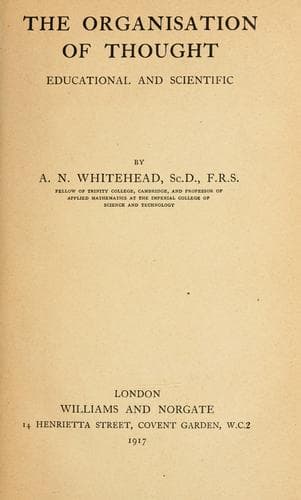
The organisation of thought, educational and scientificWhitehead, Alfred North
Philosophy
The organisation of thought, educational and scientific
Whitehead, Alfred North
Education
On pp. 192 and 193 there occurs--
"Wherever mankind ... unending uniform succession."
If I understand Kant rightly--which I admit to be very
problematical--he holds that in the act of experience we are aware
of space and time as ingredients necessary for the occurrence of
experience. I would suggest--rather timidly--that this doctrine should
be given a different twist, which in fact turns it in the opposite
direction--namely, that in the act of experience we perceive a whole
formed of related differentiated parts. The relations between these
parts possess certain characteristics, and time and space are the
expressions of some of the characteristics of these relations. Then the
generality and uniformity which are ascribed to time and space express
what may be termed the uniformity of the texture of experience.
The success of mankind--modest though it is--in deducing uniform laws
of nature is, so far as it goes, a testimony that this uniformity of
texture goes beyond those characteristics of the data of experience
which are expressed as time and space. Time and space are necessary
to experience in the sense that they are characteristics of our
experience; and, of course, no one can have our experience without
running into them. I cannot see that Kant's deduction amounts to much
more than saying that "what is, is"--true enough, but not very helpful.
But I admit that what I have termed the "uniformity of the texture of
experience" is a most curious and arresting fact. I am quite ready to
believe that it is a mere illusion; and later on in the paper I suggest
that this uniformity does not belong to the immediate relations of the
crude data of experience, but is the result of substituting for them
more refined logical entities, such as relations between relations, or
classes of relations, or classes of classes of relations. By this means
it can be demonstrated--I think--that the uniformity which must be
ascribed to experience is of a much more abstract attenuated character
than is usually allowed. This process of lifting the uniform time and
space of the physical world into the status of logical abstractions has
also the advantage of recognising another fact, namely, the extremely
fragmentary nature of all direct individual experience.
My point in this respect is that fragmentary individual experiences
are all that we know, and that all speculation must start from these
_disjecta membra_ as its sole datum. It is not true that we are
directly aware of a smooth running world, which in our speculations we
are to conceive as given. In my view the creation of the world is the
first unconscious act of speculative thought; and the first task of a
self-conscious philosophy is to explain how it has been done.
Public-domain text, read in full here on John Shaqi.
Reviews
Reviews
No reviews yet
Be the first to share your thoughts on this work.
Elsewhere in the archive
Join the Discussion
Join the discussion
Sign in to leave a comment or review.
Sign InorCreate an account