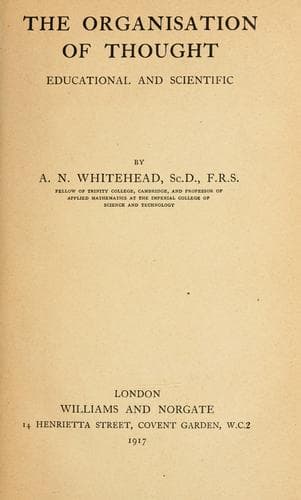
The organisation of thought, educational and scientificWhitehead, Alfred North
Philosophy
The organisation of thought, educational and scientific
Whitehead, Alfred North
Education
A measure system is a group of congruent transformations of space
into itself. Consider a rigid body occupying all space. Let this body
be moved in any way so that the particles of the body which occupied
points P_{1}, P_{2}, P_{3}, etc., now occupy points Q_{1}, Q_{2},
Q_{3}, etc. Then any point P_{1} in space is uniquely related to the
corresponding point Q_{1} in space by a one-to-one transformation with
certain characteristics. By the aid of these transformations we can
achieve the definition of distance in a way which definitely determines
the distance between any two points, provided that we can define what
we mean by a congruent transformation without introducing the idea of
distance. If we introduced the idea of distance, we should simply say
that a congruent transformation is one which leaves all distances
unchanged, _i. e._, if P_{1}, P_{2} are transformed into Q_{1},
Q_{2} then the distance P_{1}P_{2} is equal to the distance Q_{1}Q_{2}.
But mathematicians have succeeded in defining congruent transformations
without any reference to distance.
There are alternative groups of such congruent transformations, and
each group gives a different measure system for space. The distance
P_{1}P_{2} may equal the distance Q_{1}Q_{2} for one measure system,
and will not equal it for another measure system. All these different
measure systems are on the same level, equally applicable. A being
with a strong enough head could think of them all at once as applying
to space. The result so far as it interests us in respect to the
theory of relativity is explained on pp. 197-200, ending with "The
most extraordinary fact ... same metrical system." This final sentence
bears on Poincaré's assertion that the measure system adopted is
purely "conventional." I presume that by "conventional" a certain
arbitrariness of choice is meant; and in that case, I must express
entire dissent. It is true that within the circle of geometrical ideas
there is no means of giving any preference to any one measure system,
and any one is as good as any other. But it is not true that if we
look at a normal carriage wheel, and at an oval curve one foot broad
and ten feet long, we experience any arbitrariness of judgment in
deciding which has approximately the form of a circle. Accordingly to
Poincaré the choice between them, as representing a circle, is entirely
conventional.
Again, we equally form immediate judgments as to whether a body is
approximately rigid. We know that a paving stone is rigid, and that a
concertina is not rigid. This again necessitates a determinate measure
system, selected from among the others.
Accordingly we conclude that (i) each being does, in fact, employ a
determinate measure system, which remains the same, except possibly
for very small variations, and (ii) the measure systems of different
human beings agree, to within the limits of our observations. These
conclusions are not the less extraordinary because no plain man has
ever doubted them.
Public-domain text, read in full here on John Shaqi.
Reviews
Reviews
No reviews yet
Be the first to share your thoughts on this work.
Elsewhere in the archive
Join the Discussion
Join the discussion
Sign in to leave a comment or review.
Sign InorCreate an account