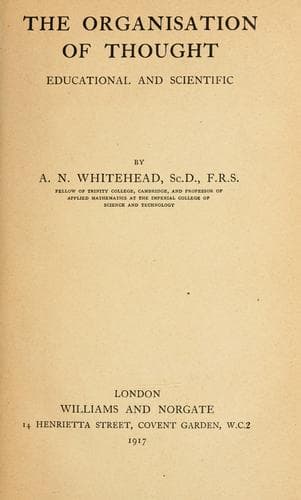
The organisation of thought, educational and scientificWhitehead, Alfred North
Philosophy
The organisation of thought, educational and scientific
Whitehead, Alfred North
Education
But the key to the reasons why it is worth while to consider seriously
the doctrine of relativity is to be found on pp. 209, 210: "Again the
velocity of light ... not involving light." Namely, we have begun to
suspect that all physical influences require time for their propagation
in space. This generalisation is a long way from being proved.
Gravitation stands like a lion in the path. But if it be the case, then
all idea of an immediate presentation to us of an aspect of the world
as it in fact is, must necessarily be abandoned. What we perceive at
any instant is already ancient history, with the dates of the various
parts hopelessly mixed.
We must add to this the difficulty of determining what is at rest
and what is in motion, and the further difficulty of determining a
definite uniform flow of time. It is no use discussing this matter
as though, but for the silly extravagant doctrine of relativity,
everything would be plain sailing. It isn't. You may be quite sure
that when, after prolonged study, you endeavour to give the simplest
explanation of a grave difficulty, you will be accused of extravagance.
I have no responsibility for the doctrine of relativity, and hold no
brief for it, but it has some claim to be considered as a comparatively
simple way out of a scientific maze.
In the first place, we use the Newtonian dynamical sets of axes,
and the Newtonian clock to extricate ourselves partially from the
difficulties of rest, motion, and time. These have proved capable
of scientific determination within the limits of our experimental
accuracy. Thus the only thing left over is the choice of the axes
at rest, which is a completely indeterminate problem on Newtonian
principles.
Again, so far as we can at present guess by adopting the theory
that all metrical influence is electromagnetic, all influences
are propagated with the velocity of light _in vacuo_. This
electromagnetic hypothesis is by no means established, but it gives
the simplest of all possible results in respect to the propagation of
influence, which we therefore adopt.
But what dynamical axes are we taking as at rest? Now our practical
choice gives a range of relative velocities small compared to that of
light. So except for certain refined experiments it does not matter.
There are two possibilities--
(i) We may assume that one set of axes are at rest, and that the others
will show traces of motion in respect to the velocity of light; or--
(ii) That the velocity of light is the same in all directions whichever
be the dynamical axes assumed.
The first supposition is negatived by experiment, and hence we are
driven to the second supposition; which immediately lands us in the
whole theory of relativity.
Public-domain text, read in full here on John Shaqi.
Reviews
Reviews
No reviews yet
Be the first to share your thoughts on this work.
Elsewhere in the archive
Join the Discussion
Join the discussion
Sign in to leave a comment or review.
Sign InorCreate an account