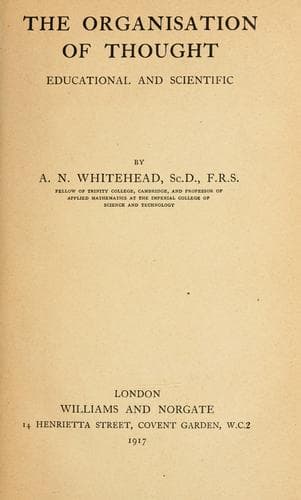
The organisation of thought, educational and scientificWhitehead, Alfred North
Philosophy
The organisation of thought, educational and scientific
Whitehead, Alfred North
Education
Consider first the social and recreative sides. For heaven's sake don't
think that you must be dull in order to be great. There is no finer
test of a nation than the way in which it fashions its amusements.
Three centuries ago after the Armada we made a good start in Southwark.
Shakespeare had his theatre here and wrote his plays to be acted in
this borough. He has walked these streets, and if you had met him in
Westminster he would, quite likely, have told you that he was going
down to the "Elephant." And even now the performances given at the
"Old Vic" are among the best in London for the purpose of seeing his
plays properly acted. What Southwark has done for the drama, she can
do for the other arts, by using this Institute as the instrument for
her energies. Why should we not be a centre for artistic enterprise--I
mean for our own art and our own enterprise, thought of by ourselves
and enjoyed by ourselves and carried through by ourselves? We shall not
always enjoy each others' creations, but the great point is to make our
own efforts. Of course all efforts require preparation and stimulus and
knowledge of what others are doing.
At the present time--interrupted for the moment by the war--a great
revolution in the art of painting is in progress throughout the world.
Its centres are Paris and Italy and London and Munich, and its origin
in the far east, in China and Japan. There are two sides as in every
revolution, the Conservatives and the Revolutionists. Our own frescoes
in a neighbouring room represent an early stage of the movement in
London. Why should we not know all about it--obtain loans of pictures
which illustrate its phases and its cross currents, and compare these
with examples of the old style?
But pictures are only one phase of art, and not the sort of art which
we ourselves can produce most easily. There are music, dancing,
recitation, literature, carving and modelling, and the various
decorative arts, such as embroidery, bookbinding, dress-making and
upholstery. This list, incomplete as it is, tells us two great
truths--you cannot separate art and recreation, and you cannot
separate art and business. The list includes items which we consider
as amusements, and items which we think of as business. We began with
dancing and ended with upholstery. Make them all beautiful.
Public-domain text, read in full here on John Shaqi.
Reviews
Reviews
No reviews yet
Be the first to share your thoughts on this work.
Join the Discussion
Join the discussion
Sign in to leave a comment or review.
Sign InorCreate an account