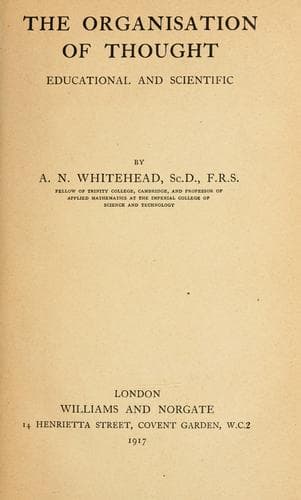
The organisation of thought, educational and scientificWhitehead, Alfred North
Philosophy
The organisation of thought, educational and scientific
Whitehead, Alfred North
Education
Let us think how this final review, closing the elementary course,
might be conducted for the more intelligent pupils. Partly no doubt
it requires a general oversight of the whole work done, considered
without undue detail so as to emphasise the general ideas used, and
their possibilities of importance when subjected to further study. Also
the analytical and geometrical ideas find immediate application in the
physical laboratory where a course of simple experimental mechanics
should have been worked through. Here the point of view is twofold, the
physical ideas and the mathematical ideas illustrate each other.
The mathematical ideas are essential to the precise formulation of the
mechanical laws. The idea of a precise law of nature, the extent to
which such laws are in fact verified in our experience, and the rôle of
abstract thought in their formulation, then become practically apparent
to the pupil. The whole topic of course requires detailed development
with full particular illustration, and is not suggested as requiring
merely a few bare abstract statements.
It would, however, be a grave error to put too much emphasis on the
mere process of direct explanation of the previous work by way of
final review. My point is, that the latter end of the course should
be so selected that in fact the general ideas underlying all the
previous mathematical work should be brought into prominence. This may
well be done by apparently entering on a new subject. For example,
the ideas of quantity and the ideas of number are fundamental to
all precise thought. In the previous stages they will not have been
sharply separated; and children are, rightly enough, pushed on to
algebra without too much bother and quantity. But the more intelligent
among them at the end of their curriculum would gain immensely by a
careful consideration of those fundamental properties of quantity in
general which lead to the introduction of numerical measurement. This
is a topic which also has the advantage that the necessary books are
actually to hand. Euclid's fifth book is regarded by those qualified
to judge as one of the triumphs of Greek mathematics. It deals with
this very point. Nothing can be more characteristic of the hopelessly
illiberal character of the traditional mathematical education than the
fact that this book has always been omitted. It deals with ideas,
and therefore was ostracised. Of course a careful selection of the
more important propositions and a careful revision of the argument are
required. This also is to hand in the publications of my immediate
predecessor in the office of president, Prof. Hill. Furthermore, in Sir
T. L. Heath's complete edition of Euclid, there is a full commentary
embodying most of what has been said and thought on the point. Thus
it is perfectly easy for teachers to inform themselves generally
on the topic. The whole book would not be wanted, but just the few
propositions which embody the fundamental ideas. The subject is not
Public-domain text, read in full here on John Shaqi.
Reviews
Reviews
No reviews yet
Be the first to share your thoughts on this work.
Join the Discussion
Join the discussion
Sign in to leave a comment or review.
Sign InorCreate an account