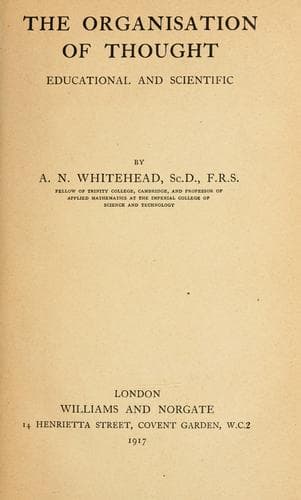
The organisation of thought, educational and scientificWhitehead, Alfred North
Philosophy
The organisation of thought, educational and scientific
Whitehead, Alfred North
Education
This brings us to the second power of mind which is to be produced by
a mathematical training, namely, the power of logical reasoning. Here
again, it is not the knowledge of the philosophy of logic which it is
essential to teach, but the habit of thinking logically. By logic, I
mean deductive logic.
Deductive logic is the science of certain relations, such as
implication, etc., between general ideas. When logic begins, definite
particular individual things have been banished. I cannot relate
logically this thing to that thing, for example this pen to that pen,
except by the indirect way of relating some general idea which applies
to this pen to some general idea which applies to that pen. And the
individualities of the two pens are quite irrelevant to the logical
process. This process is entirely concerned with the two general ideas.
Thus the practice of logic is a certain way of employing the mind
in the consideration of such ideas; and an elementary mathematical
training is in fact nothing else but the logical use of the general
ideas respecting geometry and algebra which we have enumerated above.
It has therefore, as I started this paper by stating, a double
advantage. It makes the mind capable of abstract thought, and it
achieves this object by training the mind in the most important kind of
abstract thought, namely, deductive logic.
I may remind you that other choices of a type of abstract thought
might be made. We might train the children to contemplate directly the
beauty of abstract moral ideas, in the hope of making them religious
mystics. The general practice of education has decided in favour of
logic, as exemplified in elementary mathematics.
We have now to answer the further question, what is the rôle of
logical precision in the teaching of mathematics? Our general answer
to the implied question is obvious: logical precision is one of the
two objects of the teaching of mathematics, and it is the only weapon
by which the teaching of mathematics can achieve its other object. To
teach mathematics is to teach logical precision. A mathematical teacher
who has not taught that has taught nothing.
But having stated this thesis in this unqualified way, its meaning must
be carefully explained; for otherwise its real bearing on the problem
will be entirely misunderstood.
Logical precision is the faculty to be acquired. It is the quality of
mind which it is the object of the teaching to impart. Thus the habit
of reading great literature is the goal at which a literary education
aims. But we do not expect a child to start its first lesson by reading
for itself Shakespeare. We recognise that reading is impossible till
the pupil has learnt its alphabet and can spell, and then we start it
with books of one syllable.
Public-domain text, read in full here on John Shaqi.
Reviews
Reviews
No reviews yet
Be the first to share your thoughts on this work.
Elsewhere in the archive
Join the Discussion
Join the discussion
Sign in to leave a comment or review.
Sign InorCreate an account