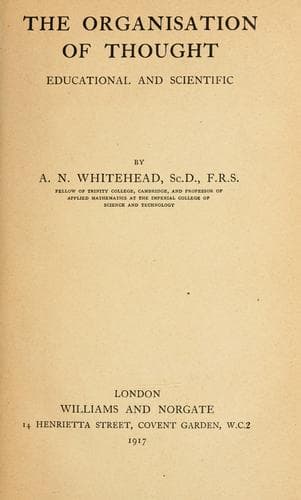
The organisation of thought, educational and scientificWhitehead, Alfred North
Philosophy
The organisation of thought, educational and scientific
Whitehead, Alfred North
Education
In the same way, a mathematical education should grow in logical
precision. It is folly to expect the same careful logical analysis at
the commencement of the training as would be appropriate at the end.
It is an entire misconception of my thesis to construe it as meaning
that a mathematical training should assume in the pupil a power of
concentrated logical thought. My thesis is in fact the exact opposite,
namely, that this power cannot be assumed, and has got to be acquired,
and that a mathematical training is nothing else than the process of
acquiring it. My whole groundwork of assumption is that this power does
not initially exist in a fully developed state. Of course like every
other power which is acquired, it must be developed gradually.
The various stages of development must be guided by the judgment and
the genius of the teacher. But what is essential is, that the teacher
should keep clearly in his mind that it is just this power of logical
precise reasoning which is the whole object of his efforts. If his
pupils have in any measure gained this, they have gained all.
We have not yet, however, fully considered this part of our subject.
Logical precision is the full realisation of the steps of the argument.
But what are the steps of the argument? The full statement of all the
steps is far too elaborate and difficult an operation to be introduced
into the mathematical reasoning of an educational curriculum. Such a
statement involves the introduction of abstract logical ideas which
are very difficult to grasp, because there is so rarely any need to
make them explicit in ordinary thought. They are therefore not a fit
subject-ground for an elementary education.
I do not think that it is possible to draw any theoretical line
between those logical steps which form a theoretically full logical
investigation, and those which are full enough for most practical
purposes, including that of education. The question is one of
psychology, to be solved by a process of experiment. The object to be
attained is to gain that amount of logical alertness which will enable
its possessors to detect fallacy and to know the types of sound logical
deduction. The objects of going further are partly philosophical, and
also partly to lay bare abstract ideas whose investigation is in itself
important. But both these objects are foreign to education.
My opinion is, that, on the whole, the type of logical precision handed
down to us by the Greek mathematicians is, roughly speaking, what we
want. In geometry, this means the sort of precision which we find in
Euclid. I do not mean that we should use his famous _Elements_ as
a text-book, nor that here and there a certain compression in his mode
of exposition is not advisable. All this is mere detail. What I do mean
is, that the sort of logical transition which he made explicit, we
should make explicit, and that the sort of transition which he omits,
we should omit.
Public-domain text, read in full here on John Shaqi.
Reviews
Reviews
No reviews yet
Be the first to share your thoughts on this work.
Elsewhere in the archive
Join the Discussion
Join the discussion
Sign in to leave a comment or review.
Sign InorCreate an account